Read your California PM contract before you sign.
Most owners sign the PMA without reading it line by line. The decision you make in the 20 minutes you spend with the contract before signing dictates the next 12 to 24 months of your relationship with the firm, your exit options, and how much of your rent reaches your unit. The clauses below are the ones that matter.
Ask for 72 hours
Ask the management company to send you the contract at least 72 hours before signing. Any manager who pressures you to sign immediately, without time to read, is showing you exactly how they will treat you as a client.
Standard PM contract clauses explained in plain English
A California property management agreement is a legally binding contract that defines the entire business relationship between you and your manager. Most are three to eight pages long, drafted by the management company’s attorney, and written to favor the manager. That does not mean the terms are non-negotiable — but it does mean you need to read every clause before signing.
The following are the standard clauses found in virtually every California PM agreement, along with a plain-English translation of what they actually mean for your property and your money.
Management fee / compensation clause
“Owner shall pay Manager a management fee equal to [X]% of gross monthly rents collected, due and payable upon collection.”
Plain English: You pay a percentage of every dollar of rent that comes in. “Collected” is the key word — most contracts specify fees are only charged on money actually received, not billed. Watch for contracts that charge fees on scheduled rent regardless of collection, which means you pay even if the tenant doesn’t. Also look for add-on fees: lease-up fees (typically 50–100% of one month’s rent per new tenant), lease renewal fees ($150–$300 per renewal), and inspection fees.
Authority to lease clause
“Owner grants Manager the exclusive right to advertise, market, and lease the property, and to execute leases on Owner’s behalf for terms not exceeding twelve (12) months.”
Plain English: The manager can sign lease agreements on your behalf without asking you each time — up to the term limit in this clause. This is normal and necessary for efficient management. Make sure the clause includes a maximum rent discount authorization and that you retain approval rights for any lease that deviates from market rate by more than a defined percentage.
Maintenance authorization clause
“Manager is authorized to make or cause to be made all ordinary repairs and maintenance to the property, and to incur expenses up to $[amount] per repair without prior Owner approval.”
Plain English: The manager can approve repairs up to this dollar threshold without calling you first. In Orange County, $250–$500 is a reasonable threshold. Watch for contracts with $1,000+ thresholds or broad “emergency” exceptions that remove the cap entirely. Also watch for provisions allowing the manager to use preferred vendors at above-market rates — this is where hidden profit is made.
Accounting and reporting clause
“Manager shall maintain books of account and shall provide Owner with a monthly statement of receipts and disbursements within [X] days after the close of each calendar month.”
Plain English: You are entitled to a monthly financial statement. The standard is delivery within 10–15 days after month-end. Watch for contracts that allow 30+ days — that is a month and a half before you see your first statement. Also check whether the contract entitles you to access real-time data or only periodic statements, and whether audit rights are preserved.
Reserve fund / owner float clause
“Owner shall maintain a reserve fund of $[amount] with Manager for the payment of expenses. Manager may replenish this reserve from collections.”
Plain English: The manager holds some of your money as a float to cover expenses. A $200–$500 reserve is reasonable. Watch for contracts requiring $1,000–$2,000 reserves — that is your capital sitting in their account, not earning interest for you. Confirm the reserve is held in a separate trust account, not commingled with the manager’s operating funds.
Indemnification clause
“Owner shall defend, indemnify, and hold harmless Manager from any claims, losses, or liabilities arising out of or related to the property or Manager’s performance under this agreement.”
Plain English: You agree to cover the manager’s legal costs if they get sued because of your property — even if the lawsuit is partly the manager’s fault. This is standard, but check whether the indemnification is mutual (manager also indemnifies you for their negligence) and whether it is capped or unlimited. An unlimited one-way indemnification heavily favors the manager.
Termination clauses: what to look for
The termination clause is the most important section in your property management agreement if there is any chance you will ever want to change managers. California law does not mandate specific termination rights for property owners — everything depends on what your contract says. A well-written termination clause protects your flexibility; a poorly written one can trap you for years.
Five things to check in your termination clause
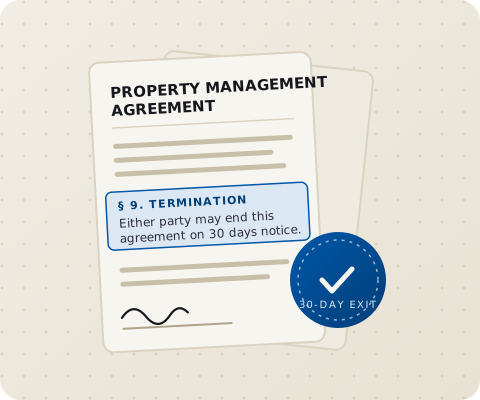
- Notice period length: 30 days is the market standard in Orange County and most of Southern California. 60 days is acceptable with negotiation. 90 days or more should prompt a hard conversation or a contract amendment before you sign.
- Form of notice required: The clause should specify whether written notice means certified mail, email, or both. If the clause only requires “written notice” without specifying delivery method, confirm this in a separate addendum. Ambiguity here will be used against you if there is a dispute.
- Termination for cause vs. convenience: Your contract should distinguish between terminating for cause (manager breach) and terminating for convenience (you simply want to switch). Terminating for cause should allow a shorter notice period and waive any early termination fees. Terminating for convenience invokes the standard notice period and fee.
- What constitutes manager breach: A strong contract defines specific acts that constitute manager breach — failure to remit rent within X days, commingling of funds, failure to maintain required licensure, abandonment. A vague breach standard makes it harder to claim termination for cause when you need it.
- Post-termination obligations: The clause should specify what happens after termination — what records must be returned, when deposits must be transferred, and what happens to any pending maintenance work or lease negotiations in progress at the time of termination.
Demand reading time
Ask the management company to send you the contract at least 72 hours before signing. Any manager who pressures you to sign immediately, without time to read, is showing you exactly how they will treat you as a client.
Early termination fees: are they enforceable in California?
Many California property management contracts include an early termination fee — a penalty you pay if you terminate the agreement before the end of a defined term. These fees are extremely common, but their enforceability under California law is more nuanced than most owners realize.
The liquidated damages test
Under California Civil Code Section 1671, a contractual provision that specifies damages in advance (a liquidated damages clause) is valid if it satisfies two conditions: (1) at the time the contract was made, it would have been impracticable or extremely difficult to fix actual damages; and (2) the amount is a reasonable estimate of actual damages, not a penalty.
Early termination fees in property management contracts are typically analyzed as liquidated damages. Courts have found such fees unenforceable when they bear no reasonable relationship to the manager’s actual lost income — for example, a fee equal to 6 months of management fees on a property that generates $200 in monthly management income is likely to be viewed as a penalty rather than a genuine estimate of damages.
However, the burden of proving unenforceability is on you, not the management company. Going to court to challenge a fee costs time and money. Your best strategy is to negotiate the early termination fee before signing, not challenge it after the fact.
Common fee structures and what is reasonable
| Fee structure | Common range | Assessment |
|---|---|---|
| Flat dollar amount | $500–$1,500 | Acceptable in range; negotiate above $1,000 |
| Equivalent to 1–2 months management fees | ~$150–$600 typical OC property | Generally reasonable, likely enforceable |
| Equivalent to 3–6 months management fees | ~$450–$1,800 typical OC property | Borderline — negotiate or seek attorney review |
| Remainder of contract term in full fees | Varies widely | High risk of being deemed a penalty |
| No early termination fee | $0 | Ideal — some managers (incl. NGC) charge zero |
Fee waivers and carve-outs
Even in contracts with early termination fees, there are often carve-outs that waive the fee under specific circumstances. Common waiver provisions include: termination due to the manager’s material breach, sale of the property, owner relocation to occupy the property, and mutual written consent to terminate. Always ask whether these carve-outs are included and, if not, negotiate to add them.
Automatic renewal traps
Automatic renewal clauses are one of the most overlooked — and most costly — provisions in California property management contracts. They work like this: the contract has a defined initial term (commonly one year), and at the end of that term, the agreement automatically renews for another full year unless either party provides written notice of non-renewal before a specified deadline.
The trap is in the deadline. Many California management agreements require non-renewal notice 60 to 90 days before the contract anniversary date. Miss that window by even one day and you are locked in for another full year — or subject to an early termination fee to exit. Property owners who are not tracking their contract anniversary dates routinely get caught by this provision.
If your contract already auto-renewed
You have two options: (1) wait until the next non-renewal window and send timely notice, or (2) negotiate an exit with your manager, potentially paying a reduced termination fee. Before accepting the status quo, check whether the auto-renewal clause is enforceable — some California courts have declined to enforce surprise auto-renewal provisions when the renewal term and notice requirements were not adequately disclosed at signing.
How to protect yourself
- When you sign any PM agreement, immediately calendar the non-renewal deadline with a reminder 30 days earlier.
- Negotiate to reduce or eliminate automatic renewal clauses entirely, replacing them with month-to-month continuation after the initial term.
- If you cannot eliminate the clause, negotiate the non-renewal notice period down to 30 days — the same as your termination notice period.
- Consider adding a clause that requires the manager to send you a written reminder of the upcoming renewal 60 days before the non-renewal deadline. NGC includes this as a standard practice.
Owner rights vs. manager obligations
A well-balanced property management contract is explicit about what you are entitled to and what your manager is obligated to deliver. Many contracts drafted by management companies are heavy on owner obligations and light on manager obligations. The following table summarizes what a fair contract should include in both columns.
| Your rights as owner | Manager’s obligations |
|---|---|
| Monthly itemized owner statement within 15 days of month-end | Maintain accurate, itemized books of account for the property |
| Real-time access to owner financial portal | Provide technology infrastructure for owner access |
| Approval on repairs above the authorization threshold | Obtain authorization before exceeding the repair threshold |
| Notification of any vacancy within 48 hours | Report vacancies promptly and begin marketing immediately |
| Copies of all executed leases and addenda | Retain and provide all executed lease documents on request |
| Written accounting of security deposits at all times | Hold all security deposits in a separate trust account per CA law |
| Notification of any legal notice received by tenants | Forward all legal notices to owner within 24–48 hours |
| Annual rent market review and recommendation | Proactively advise on market rent benchmarks each lease cycle |
| Transfer of all records within 5 business days of termination | Cooperate fully with transition to successor management |
Red flags in California PM contracts
After reviewing hundreds of Orange County property management agreements, the following contractual provisions are the most reliable indicators of a problematic management relationship. If you see more than two of these in any contract you are reviewing, think carefully before signing.
-
!Maintenance authorization threshold above $500 without clear emergency definitionA high threshold without a precise definition of “emergency” gives the manager effectively unlimited spending authority on your property. Some managers have used this provision to generate significant vendor kickback income at owners’ expense.
-
!Vendor exclusivity or “preferred vendor” requirementAny clause that requires you to use only the manager’s approved vendors — with no transparency on pricing or markups — is a financial red flag. Preferred vendor arrangements can result in you paying 20–40% above market for routine maintenance.
-
!One-sided indemnification with no manager liability capIf the contract requires you to indemnify the manager against everything, including their own negligence, with no corresponding obligation for the manager to indemnify you, you are accepting essentially unlimited liability for your manager’s mistakes.
-
!Early termination fees exceeding 3 months of management feesFees at this level bear little relationship to the manager’s actual lost income and look more like a penalty designed to discourage switching. They are also more likely to face enforceability challenges if you push back.
-
!Automatic renewal with non-renewal notice period longer than 60 daysA 90-day or longer non-renewal window combined with a one-year auto-renewal term can effectively trap you for two years if you miss the window once. This provision, when combined with a substantial early termination fee, is particularly restrictive.
-
!No performance benchmarks or accountability provisionsA contract that specifies your obligations in detail but includes no service-level standards for the manager — no vacancy time targets, no maintenance response time requirements, no statement delivery timeline — is written entirely in the manager’s favor.
-
!Procuring cause commission tail with no sunset dateEntitling an outgoing manager to leasing commissions indefinitely — for the full duration of any tenancy they originally placed — can create a permanent financial obligation to a company you are no longer working with. Negotiate a 12-month sunset on any procuring cause provision.
What the NextGen Coastal contract looks like
Most property management companies will not show you their contract until you are ready to sign. We post ours openly because transparency is how we build trust. Here is a plain-English summary of how the NGC property management agreement differs from the problematic clauses described above.
Transparent by default
Management fee: 5.9% of collected monthly rent, with no vacancy fee and no fees on uncollected rent. Maintenance threshold: $350 per repair, with prior authorization required above that amount. No preferred-vendor exclusivity — we use licensed, bonded contractors at market rates and provide you with invoices. Early termination fee: $0. We believe in earning your business every month. Termination notice: 30 days written notice, by email and certified mail. Auto-renewal: none — the NGC agreement continues month-to-month after the initial 90-day onboarding period. Records delivery: 5 business days after termination, guaranteed in writing.
We are not suggesting every management company needs to match every one of these terms exactly. Management fee percentages, for example, reflect the scope of services included — a company charging 10% may provide leasing, maintenance coordination, compliance review, and financial reporting at a level that justifies the rate. What matters is that the contract is clear, the terms are negotiated, and you understand what you are agreeing to before you sign.
If you would like to review a sample of the NGC agreement before committing, we are happy to share it. No obligation, no pressure. We think transparency at the contract stage predicts transparency throughout the management relationship — and we are willing to back that with a written agreement that reflects it.
California PM contracts — frequently asked questions
The questions Orange County owners ask most often before they sign a management agreement.
Ready to see what a transparent contract looks like?
We’ll send you a sample of the NGC agreement and review your current contract for free. No obligation. Most owners find at least two clauses they wish they had negotiated differently.