How long does a property-manager switch take in California?
The legal clock is 30 days, set by the notice period in your existing PMA. The actual work inside that window is what determines whether the handoff is clean. This is the day-by-day version — standard 30-day contracts, the 60-/90-day variants, and the emergency-termination path for cause.
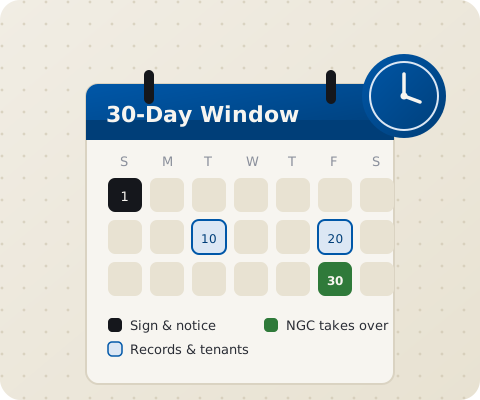
35–45 days end to end
Based on NGC’s transition protocol across 200+ switched accounts. The bulk of the window is the legal notice period; your own time investment is about 90 minutes.
The short answer
For most California owners, a switch runs 30 days from certified-mail receipt to handoff, with a few extra days on either end for sign-up and the first owner statement — roughly 35 to 45 calendar days end to end. The bulk of that window is the legal notice period running out under your existing PMA. NGC’s active coordination inside that window runs about 10 business days. Your own time investment is about 90 minutes across the entire period.
Fast track
If:
- Your contract has no required notice period (uncommon)
- Your current manager materially breached the contract (termination for cause)
- You have a documented vacancy with no active tenant to transition
Standard
If:
- 30-day written notice required (most California contracts)
- Active tenant in place
- No contract disputes with outgoing manager
- Standard security deposit reconciliation
Extended
If:
- 60 or 90 day notice period in contract
- Evergreen auto-renewal that must expire
- Multi-property portfolio requiring phased transition
- Disputed termination with outgoing manager
The decision is the delay, not the mechanics
Every day between deciding to switch and signing the new management agreement is a wasted day. Once you sign, your new manager can immediately serve termination on the old manager and start the clock. Procrastination on the decision, not the mechanics of switching, is what actually delays most transitions.
The standard day-by-day timeline
About 45% of California property management contracts use a 30-day written notice requirement. If yours is in that group, here is the complete walkthrough of what happens.
Initial consultation & decision
You meet with the prospective new manager (NGC or another firm). They review your current management agreement, recent owner statements, rent roll, and your specific concerns. This typically takes 30–45 minutes via phone, Zoom, or in-person meeting. You get a concrete proposal with fees, services, and projected economics.
Review & signature
You review the proposed management agreement. Reputable managers send contracts in e-signature platforms (DocuSign, PandaDoc, HelloSign). Signing takes about 20 minutes. Key items to verify before signing:
- Monthly management fee percentage
- Lease-up / tenant placement fee structure
- Maintenance markup policy (0% vs. 10-20%)
- Notice period for you to terminate this new contract (should match or beat your old one)
- Any auto-renewal clauses
Termination notice served to current manager
Your new manager drafts a termination letter on your behalf. It's sent via certified mail with return receipt (creating a dated legal record) and typically emailed to the current manager as well. The letter cites the specific notice clause in your current PMA, gives the effective termination date exactly matching the notice period, and requests standard records transfer. The 30-day clock starts now.
Records collection & audit
Your new manager begins requesting and reviewing records from the outgoing manager. Standard items:
- Current signed lease agreements for each unit
- Rent roll with payment history
- Security deposit ledger showing balances held per tenant
- Maintenance history and open work orders
- Vendor contracts (landscaping, pest control, HOA correspondence)
- Most recent 12 months of owner statements
- Any tenant correspondence relating to active issues
You typically receive a shared folder (Dropbox, Google Drive, or a new manager portal) where all collected records are organized for your reference.
Tenant notification letters drafted
Your new manager drafts tenant notification letters explaining the change. Important elements: confirmation that the lease remains fully in force, updated payment instructions (new account, new online portal), emergency contact information for the new property manager, and a warm welcome. In Orange County and LA County neighborhoods with significant Spanish-speaking populations, letters are drafted in both English and Spanish.
You review and approve the letter before it's sent. This is often the moment owners realize how much communication their old manager was NOT doing — they're seeing a professional, clear tenant communication for the first time.
Tenant notification sent & onboarded
Tenant letters are sent via email and hard copy mail. Tenants typically receive them within 2-3 business days. New payment instructions take effect for the next rent cycle (the one after termination is complete). Tenants are onboarded into the new manager's portal with their individual login credentials, lease copies, and payment setup. Most tenants complete the onboarding within 3-5 days with minimal friction.
Physical property inspection
Your new property manager conducts an in-person inspection of each unit with proper 24-hour notice to tenants (per California Civil Code §1954). Inspection covers: habitability systems (HVAC, plumbing, electrical, smoke/CO detectors, deadbolts), unit condition, common areas, exterior and landscaping, and any visible maintenance issues. Photos are taken, a condition report is drafted, and both copies are delivered to you.
This inspection is the baseline for the new manager's file and often surfaces deferred maintenance the previous manager wasn't flagging. You get a candid look at the property's actual state.
Termination effective — final reconciliation
The 30-day notice period ends. The outgoing manager is required to: transfer all held tenant security deposits to the new manager; transfer any rent collected during the notice period; transfer all remaining keys, access codes, and gate remotes; and provide a final accounting statement. Your new manager audits the received deposit amounts against the lease records to confirm accuracy.
First rent collected under new manager
For most tenants, the first rent payment under the new manager arrives in the first rent cycle after termination. Payments route to the new trust account, get reconciled, and appear in your owner portal. Your first NGC owner statement is drafted the following month.
First owner statement & disbursement
Most professional managers issue owner statements monthly, typically 5-10 business days after month-end. Your first statement includes rent collected, all operating expenses, the management fee, and your net disbursement — which arrives via ACH or check. The transition is fully complete.
60-day and 90-day notice contracts
Some California PMAs (roughly 25-30% of contracts, based on NGC's onboarding intake data) require 60 or 90 days' written notice. If your contract is in this category, the overall timeline extends proportionally. Here's what's different.
What changes with a longer notice period
- The termination notice is served the same day — you don't wait to serve it.
- Records collection can begin earlier — often immediately after termination is served, giving your new manager more time to audit and reconcile before taking over.
- Tenant notification is sent about 2-3 weeks before effective termination — not immediately, since tenants shouldn't get confused about when their payment address actually changes.
- The property inspection is scheduled in the last 2 weeks of the notice period, so the condition report reflects the unit's state right before handoff.
- You may pay one or two additional months of management fees to the outgoing manager during the extended notice period — which is why 60/90 day contracts are inherently less owner-friendly.
Can I negotiate a shorter notice?
Sometimes. If your outgoing manager is reasonable and you provide written cause, they may agree to reduce the notice period to 30 days or waive it entirely. This is most likely when:
- The outgoing manager is downsizing or closing its portfolio anyway
- The relationship has been contentious and both parties want it over
- You have documented performance issues creating an implicit threat of a material-breach claim
- You're willing to pay a one-time fee (often equivalent to one month's management) in exchange for immediate release

Emergency termination — getting out fast
In limited circumstances, California law and the common-law rules of contract allow you to terminate a management agreement immediately for cause — no notice period required. These are strict standards; not every annoyance qualifies.
Grounds for immediate termination
- Trust fund violations. The manager has commingled owner funds with operating funds, failed to maintain a proper trust account under Business & Professions Code §10145, or cannot account for held security deposits.
- Expired or suspended DRE license. The manager or responsible broker's real estate license has lapsed, been suspended, or been revoked.
- Fraud or misappropriation. The manager has fabricated invoices, paid themselves unauthorized fees, collected rent not reported on owner statements, or otherwise misappropriated funds.
- Failure to make required disbursements. Owner funds have been withheld beyond the statutorily permitted period (typically 25 days under DRE rules).
- Abandonment. The manager has ceased active management — no answered phones, no response to tenant emergencies, no rent collected, no reports.
- Material uncured breach. A specifically documented, written demand for cure has not been complied with within a reasonable time.
Improper termination creates litigation exposure
Terminating for cause without serving the standard notice period creates legal risk if a judge later finds the breach wasn't material. Before invoking emergency termination, have a California real estate attorney review the facts. The typical cost is $500-$1,500 for a consultation and demand letter — trivial compared to the litigation exposure of an improper termination.
Emergency timeline — 7 to 14 days
When grounds for immediate termination exist and documentation supports it, the emergency timeline looks like this:
- Day 1: Consultation with attorney + new manager; signed PMA with new manager; demand-to-cure letter sent to old manager with short deadline (often 48-72 hours)
- Day 3-5: Cure deadline expires; formal termination letter sent citing specific uncured breaches
- Day 5-10: Records transfer; if outgoing manager resists, DRE complaint and/or demand for injunctive relief
- Day 7-14: Tenants notified; deposits transferred; new manager fully operational
What slows transitions down
Even with both managers acting in good faith, certain circumstances can add days or weeks. Know these upfront so you can plan around them.
| Factor | Typical delay | Mitigation |
|---|---|---|
| Holiday season (Dec 20 - Jan 5) | 5-10 days | Avoid starting transitions in late December; start early December or mid-January |
| Multiple properties with different tenants | 5-15 days (per property) | Phase the transition 1-2 properties at a time for large portfolios |
| Outgoing manager resisting records transfer | 10-30 days | Involve attorney; file DRE complaint if needed; reach out to outgoing broker-of-record |
| Active tenant dispute at transition time | Case-by-case | Have new manager brief tenant on the dispute before transition; keep continuity of case work |
| Security deposit discrepancies | 5-10 days | Audit deposits before signing termination; require reconciliation as part of final notice |
| Pending maintenance invoices | Generally 0 (new manager picks up) | Clarify in new PMA who pays pending invoices vs. who takes over future work |
| HOA board approvals for change of manager | 5-20 days | For condos, confirm HOA requirements; schedule board approval concurrent with notice period |
Multi-property and multi-unit transitions
If you have multiple properties or a larger multifamily portfolio, the transition mechanics are fundamentally the same as a single unit — but the coordination effort scales with size. A few notes on larger transitions.
Portfolio timelines by size
- 1-3 units: Standard 30-45 day timeline applies.
- 4-10 units: Standard 30-45 day timeline; 4-8 hours more NGC coordination labor than a single unit.
- 11-25 units: 45-60 day timeline is common; records audit and tenant onboarding takes longer with more units.
- 25+ units: 60-90 day timeline; often handled as a phased transition where buildings are transitioned in groups of 10-15 units to manage operational load.
Benefits of phased transitions
For larger portfolios, phasing the transition (moving units in groups rather than all at once) has operational advantages: tenants in each group receive dedicated attention during their handoff; records audit time is more manageable; and any issues surfaced during early groups inform later groups' procedures. NGC typically recommends phasing for any portfolio over 20 units.
The NGC transition timeline
For owners switching from a standard 30-day notice contract, here is NGC's specific operational timeline.
| Day | NGC action | Your action |
|---|---|---|
| Day 1 | Consultation and proposal | 30-45 min call |
| Day 2 | Send management agreement for e-signature | 20 min review and sign |
| Day 3 | Draft and serve certified termination letter | None |
| Days 4-7 | Begin records collection and audit | Share current manager portal access |
| Days 8-14 | Complete records audit; draft tenant letters | Review and approve tenant letter |
| Day 15 | Send tenant notification letters | None |
| Days 15-25 | Tenant portal onboarding; property inspection scheduled | 10 min check-in call |
| Day 25 | Physical property inspection with condition report | Review report (optional) |
| Day 30 | Termination effective; security deposit transfer | None |
| Days 31-35 | First rent collected under NGC | None |
| Day 40-45 | First owner statement delivered | 15 min review |
NGC absorbs the coordination labor
Spread across 45 days, your active participation in the transition adds up to roughly 90-120 minutes. NGC absorbs the rest of the coordination labor as part of onboarding. No charge, no billable time — this is part of our new-owner service. Start your transition today →
Switching timeline questions
The most common questions owners ask about how long a switch takes.
Every day you wait costs you money
NGC transitions owners in 35-45 days with 90 minutes of your total time. The notice period runs whether you've signed the new agreement or not — so start today.