15 red flags your property manager has stopped earning the fee.
The specific patterns that separate a manager worth keeping from one worth replacing — with the dollar threshold or compliance trigger that turns each flag into a real switch decision. Examples from OC owners.
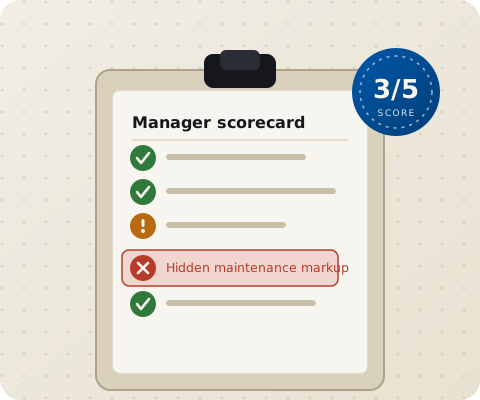
Count the flags
One or two isolated issues may be correctable. Four or more across multiple categories — especially any financial or legal flag — is a reliable signal that switching is the better investment.
Most OC owners don’t fire their property manager after a single bad month. They stay through three, four, sometimes six — absorbing slow payouts, missed maintenance calls, leases that haven’t been updated for current law — because switching feels complicated and each individual problem feels tolerable. The guide below names the problems precisely so the decision is based on specifics rather than accumulated frustration.
The 15 red flags below are organized into five categories: financial, communication, maintenance, legal compliance, and performance. For each red flag we give you a real-world example, a short explanation of the underlying problem, specific steps to take, and an honest verdict: fixable or time to switch.
Keep a running count
Read through all 15 items and keep a mental count of how many apply to your current manager. One or two isolated issues may be correctable. Four or more across multiple categories — especially any financial or legal red flags — is a reliable signal that switching is the better investment of your time and energy.
Financial red flags
The most consequential category — financial flags directly reduce your net operating income and, in some cases, expose you to liability for your manager’s accounting failures. Never dismiss a financial anomaly as administrative noise without investigating it in writing.
Payouts are consistently late or unclear
In Orange County, a well-run property management company should deposit rent proceeds into your account within 3–5 business days of collecting rent from tenants — typically in the first week of each month. If your manager routinely holds funds for 15–30 days, citing “escrow processing” or “trust account cycles,” you are effectively giving them an interest-free loan of your own money every single month.
Real-world example: An OC landlord with four units was receiving payouts on the 25th of each month, despite rent being collected on the 1st. At $6,400/month in gross rent, that 24-day float meant the management company was holding nearly $6,400 of this owner’s money interest-free — every month.
What to do: Request the company’s written payout policy. Confirm what date rent is collected versus what date owner funds are disbursed. A delay beyond 7 business days warrants a written explanation.
Line-item charges you can’t verify
Every legitimate expense charged to your account should be documentable with an invoice, work order, or receipt. When your monthly owner statement contains vague charges like “misc maintenance,” “admin fee,” or “coordination charge” with no corresponding documentation, that is either sloppy bookkeeping or something worse. Either way, you are paying for something you cannot verify.
Real-world example: A Huntington Beach landlord discovered a recurring $75 “property inspection fee” on monthly statements — for inspections that were never logged in the management portal and never documented with photos or a written report. Over two years, that was $1,800 for work that may never have occurred.
What to do: Request supporting documentation for every line item on your last three statements. A manager who resists this request or cannot produce invoices is a manager who cannot be trusted with your finances.
Maintenance vendor markups above market rate
Many property management companies have preferred vendor relationships and charge owners a coordination markup — typically 8–12% — on top of the vendor’s invoice. This is industry-standard when disclosed in the management agreement. What is not standard is charging undisclosed markups of 20–35%, or using captive vendor relationships where the manager has a financial interest in the vendor being chosen.
Real-world example: An owner in Irvine received a $680 invoice for a water heater replacement. A quick call to a licensed plumber revealed the market rate for the same job was $380–$420. The 60%+ overage was traced to an undisclosed referral arrangement between the management company and their preferred plumbing contractor.
What to do: Get an independent quote on a recent maintenance job. If actual costs consistently run 20%+ above independent estimates, you have a vendor conflict of interest problem.
Communication red flags
Communication failures are frequently dismissed as personality differences or busy-season delays. But consistent communication breakdowns are management infrastructure failures — and in many cases the first visible symptom of a more serious operational problem underneath.
Calls and emails go unanswered for days
A property manager who takes more than 24–48 business hours to respond to owner inquiries is either understaffed, disorganized, or prioritizing other clients at your expense. In a market like Orange County — where tenant situations can move fast and maintenance emergencies can escalate quickly — communication lag is not a minor inconvenience. It is a structural risk.
Real-world example: A Costa Mesa owner reported a potential roof leak on a Monday morning. After four unanswered calls and two unanswered emails over three days, she contacted the tenant directly and learned the ceiling had been dripping since the previous week. The eventual repair cost was double what it would have been with prompt action.
What to do: Send a written message documenting the delay and requesting a guaranteed response window. If the pattern continues over 30 days, the issue is not fixable without a fundamental change in how the company is staffed.
You learn about property issues from your tenants
If your tenants are contacting you directly about maintenance problems, lease renewals, or property issues — rather than going through your manager — something is wrong. Either the manager has failed to establish proper communication protocols with tenants, or tenants have lost confidence that the manager will act and are escalating to you out of frustration.
Real-world example: A Newport Beach investor learned from her own tenant that the HVAC had been “broken for six weeks.” The property manager had logged the initial work order but failed to follow up after the first vendor no-showed. The tenant stopped reporting to the manager and called the owner directly.
What to do: When a tenant contacts you directly about a management issue, forward the communication to your manager in writing and ask for a status update with a 48-hour deadline. A pattern of this — more than twice in a quarter — suggests your manager has lost the tenant’s confidence.
No proactive updates — only reactive responses
A good property manager surfaces information before you have to ask for it: lease renewals coming up, rent market data suggesting an adjustment, a tenant who is two days late, a vendor quote for upcoming deferred maintenance. If your manager only communicates when you initiate contact, you are not getting a managed property — you are getting an answering service.
Real-world example: An owner in Laguna Hills discovered her tenant had moved out without notice only because she happened to check the management portal herself. No vacancy notification had been sent. The unit sat empty for 11 days before anyone thought to list it — at peak leasing season.
What to do: Ask your manager for a written summary of the last 90 days of activity on your property. If the document is thin or the manager struggles to produce it, the lack of proactive communication is not a personality style — it is a service gap.
Maintenance red flags
Maintenance management is where many property management relationships quietly deteriorate. The problems are easy to miss from a distance — they show up on your statements as routine expenses — but over time, deferred maintenance and vendor mismanagement compound into significant property value loss.
Maintenance work orders closed without confirmation
A work order should not be marked “completed” until the repair has been verified — either through a follow-up communication with the tenant or a physical inspection. Managers who routinely close work orders without tenant confirmation are creating a paper trail that looks organized while the actual problem may remain unresolved and the tenant’s satisfaction unverified.
Real-world example: An Anaheim duplex owner noticed her management portal showed six “completed” maintenance tickets in three months. When she reviewed the next lease renewal with the tenant, she discovered two of those tickets — a broken door latch and a leaking sink — had never actually been repaired. The vendor had been paid; the manager had received the invoice; nobody had confirmed the work was done.
What to do: Randomly audit 2–3 recently closed work orders by contacting the tenant directly to confirm the repair was completed satisfactorily. If you find unresolved items marked complete, raise the issue in writing and request a new inspection protocol.
No documented annual property inspections
California landlords have a legitimate need — and in some jurisdictions a legal obligation — to inspect their properties periodically. A good property manager schedules documented inspections at move-in, annually during tenancy, and at move-out. If your manager cannot provide written inspection reports with dated photos for your properties, your maintenance risk is essentially unmanaged.
Real-world example: After a four-year tenancy ended, an owner in Garden Grove discovered the tenant had made unauthorized modifications to two interior walls and caused significant water damage under a bathroom cabinet. No documented mid-tenancy inspections had been performed. Proving the damage occurred during that tenancy — and recovering from the deposit — required months of dispute resolution.
What to do: Request copies of the last inspection report for your property. If your manager cannot produce a dated, photo-documented inspection report, schedule one immediately in writing and set a deadline.
Deferred maintenance that keeps getting pushed back
Some maintenance — HVAC servicing, exterior paint, roof inspections — has a natural cycle. When these items are repeatedly flagged as “needs attention” on quarterly reports but never scheduled and completed, the manager is transferring risk to you. Deferred preventive maintenance eventually becomes expensive reactive maintenance, and the cost differential is rarely small.
Real-world example: An OC owner had a note in her management portal that the water heater was “approaching end of life” for 14 months. When it failed without warning on a weekend, the emergency replacement cost was $1,100 — versus an estimated $650 for a scheduled, non-emergency replacement. The manager had never followed up on the flagged item.
What to do: Request a deferred maintenance log for your property. For each item flagged but not completed, ask for a specific scheduled date — not a range. If the manager cannot commit to dates, the deferred items will continue to compound.
Legal compliance red flags
California has among the most complex landlord-tenant laws in the country, and they change regularly. A property manager who is not actively tracking and implementing compliance is not just providing subpar service — they are exposing you to statutory penalties, litigation, and potential loss of your ability to enforce leases.
Leases not updated for recent California legislation
California’s AB 1482 (statewide rent control on qualifying properties), AB 12 (security deposit reform limiting deposits to one month’s rent for most residential units, effective July 1, 2024), and SB 567 (strengthened just-cause eviction rules) have all required significant lease updates in the past three years. If your leases do not reflect these laws, you may be holding non-compliant lease agreements that are either unenforceable in key provisions or create direct liability.
Real-world example: A landlord in Fullerton attempted to charge a new tenant a two-month security deposit on a single-family rental in early 2025 — following his manager’s standard lease template, which had not been updated to reflect AB 12. The tenant filed a small claims complaint. The owner was required to refund the excess deposit plus interest.
What to do: Ask your manager directly: “Has our lease template been updated for AB 1482, AB 12, and SB 567?” If they cannot answer confidently and specifically, request the current lease version and compare it against current law — or consult a California landlord-tenant attorney.
Security deposit handling that doesn’t meet California standards
California Civil Code Section 1950.5 governs security deposit collection, holding, and return with strict requirements. Deposits must be held in a trust account, itemized deductions must be provided within 21 days of move-out, and pre-move-out inspection rights must be offered in writing. A manager who cannot document their deposit handling procedures — or who commingles deposits with operating funds — is creating significant liability for you.
Real-world example: After a tenant move-out, an OC owner’s previous manager failed to provide the required itemized deduction statement within 21 days. The tenant filed in small claims court. The judge awarded the tenant the full deposit amount plus a statutory penalty — the owner paid for an administrative failure that had nothing to do with the condition of the unit.
What to do: Request a written summary of how your manager handles security deposits: where they are held, how they are tracked, and what their move-out inspection and deduction procedure is. Any hesitation or vagueness in this answer is a serious warning sign.
No DRE license verification on file
In California, anyone who manages property for others for compensation must hold a valid real estate broker license issued by the Department of Real Estate (DRE). If your property manager cannot produce a current, valid DRE license number — or if a quick search at bre.ca.gov shows a lapsed, suspended, or restricted license — every management contract they have written and every action they have taken on your behalf may be legally compromised.
Real-world example: A landlord in Orange County discovered — only after a maintenance dispute escalated — that the property management company he had been using for two years was operating on an expired broker license. The company’s license had lapsed 18 months earlier. Multiple owner agreements, tenant leases, and commission arrangements were now legally questionable.
What to do: Verify your manager’s DRE license right now at bre.ca.gov. Confirm the license is active, that it covers property management activities, and that it has not been subject to disciplinary action. This takes two minutes and should be part of any ongoing due diligence.
Performance red flags
Performance red flags are often the last category owners investigate because they require market context — you need to know what “good” looks like before you can identify underperformance. In the Orange County market, benchmarks are clear and managers who fall consistently short of them are costing you money in ways that do not show up on any statement.
Vacancy periods consistently exceeding 30 days
In Orange County’s rental market, the average unit should lease in 18–25 days when priced appropriately and marketed effectively. When your properties routinely sit vacant for 30, 45, or 60+ days, you are paying for that vacancy in lost rent — and in many cases, the manager’s incentive to fill the vacancy quickly is blunted by management fees that continue to accumulate or placement fees that get charged regardless of the quality of the tenant found.
Real-world example: An investor in Mission Viejo experienced three consecutive vacancies of 42, 51, and 38 days on a 2-bedroom unit. Industry average for comparable units in that area was under 22 days at the time. At $2,100/month in market rent, those excess vacancy days cost the owner approximately $4,550 in additional lost income above what a market-performing manager would have produced.
What to do: Ask for your average days-on-market over the last 12 months and compare it to OC market averages available from Zillow, Apartments.com, or local property management association data. If yours is running 50% or more above average, ask for a specific written marketing plan for your next vacancy.
Below-market rents with no renewal strategy
Orange County rents have moved upward meaningfully over the past several years. A manager who has not recommended a single rent increase in 24 months is almost certainly leaving money on the table. On a property where market rent has moved from $2,200 to $2,500/month, a manager who hasn’t had the renewal conversation has cost you $3,600/year in foregone income — and may have made future increases more difficult to implement.
Real-world example: An Anaheim Hills landlord reviewed her rental history after two years with the same manager. Market rents for comparable units had increased by approximately 11% during that period. Her rent had been flat. The manager had simply been auto-renewing the lease at the same rate to avoid the renewal conversation. The correction required navigating AB 1482 limits and a tenant negotiation that could have been handled incrementally.
What to do: Request a rent comparison analysis for your units against current market comps. If your manager cannot produce this within 48 hours or lacks access to current comparable data, they are not managing your asset proactively — they are just collecting fees.
High tenant turnover with no retention effort
Tenant turnover is one of the most expensive recurring costs in residential property management. Between vacancy loss, cleaning, repairs, and placement fees, a single tenant turnover on an OC rental can easily cost $2,500–$5,000 in direct costs plus 3–6 weeks of lost rent. A manager who makes no proactive effort to retain good tenants — no renewal outreach, no relationship maintenance, no flexibility on lease terms for long-term, low-risk tenants — is generating fees for themselves while maximizing your costs.
Real-world example: A Seal Beach owner with four units had experienced seven tenant turnovers in three years under the same management company. The manager’s contract included a leasing placement fee of one month’s rent per new lease. The owner eventually calculated that the manager had earned $14,800 in placement fees during a period when a retention-focused approach likely could have held at least four of those tenants in place.
What to do: Ask your manager for the lease renewal rate across their portfolio — not just yours. A company with a renewal rate below 60% has either a tenant satisfaction problem or a structural incentive that favors turnover. Neither is acceptable.
Quick reference: all 15 red flags at a glance
Use this table to track which red flags apply to your current manager.
| # | Red flag | Category | Verdict |
|---|---|---|---|
| 1 | Payouts consistently late or unclear | Financial | Switch |
| 2 | Unverifiable line-item charges | Financial | Switch |
| 3 | Vendor markups above market rate | Financial | Switch |
| 4 | Calls and emails unanswered for days | Communication | Possibly fixable |
| 5 | Learning about property issues from tenants | Communication | Possibly fixable |
| 6 | No proactive updates, only reactive responses | Communication | Switch |
| 7 | Work orders closed without tenant confirmation | Maintenance | Possibly fixable |
| 8 | No documented annual inspections | Maintenance | Possibly fixable |
| 9 | Deferred maintenance repeatedly pushed back | Maintenance | Possibly fixable |
| 10 | Leases not updated for recent CA legislation | Legal | Switch |
| 11 | Security deposit handling gaps | Legal | Switch |
| 12 | No valid DRE license on file | Legal | Switch |
| 13 | Vacancies exceeding 30 days consistently | Performance | Possibly fixable |
| 14 | Below-market rents with no renewal strategy | Performance | Possibly fixable |
| 15 | High turnover with no retention effort | Performance | Switch |
Fixable vs. time to switch: the deciding framework
Not every red flag is grounds for immediate termination. The distinction between a fixable problem and a reason to switch comes down to three questions:
- Is this a process failure or a values failure? A manager who is slow to close work orders because of a broken ticketing system has a process problem. A manager who charges for inspections that were never done has a values problem. Process problems can be corrected. Values problems cannot.
- Has the issue been raised in writing and gone unresolved? If you have documented a problem, given a reasonable deadline, and the manager has either ignored the issue or responded defensively, the evidence now says the problem is not solvable within this relationship.
- Does it involve finances, legal compliance, or both? Financial and legal red flags carry the highest stakes. A manager who cannot or will not handle your money correctly or keep your leases compliant is exposing you to ongoing, compounding risk. In these categories, the threshold for switching should be low and the tolerance for repeat offenses should be zero.
Check your contract first
Before serving termination notice, review your current management agreement for the termination clause, required notice period (typically 30 days), and any early termination fees. Our termination letter guide and California PM contracts overview walk through this in detail.
The switch takes 10 business days
When OC landlords switch to NGC, we handle the entire transition — termination notice, records collection, tenant communication, and onboarding — in 10 business days. There is no gap in rent collection, no deposit confusion, and no tenant disruption. Talk to us about making the switch.
Frequently asked questions
The questions OC owners ask most often before deciding to switch.
Spotted multiple red flags? Let’s talk.
Get a free proposal from NextGen Coastal in 24 hours. We’ll review your current contract, walk you through the exit, and handle the entire switch — at no charge to you.