The real cost of switching property managers.
Every fee, every line item, and the exit-side tactics a minority of firms use on the way out. The short version: most California owners pay $0 to $500 out of pocket and recover it inside a quarter. The math is below.
$0 to switch
NGC charges $0 in onboarding, setup, or transition fees for owners switching from another manager. Certified termination notice, records audit, tenant notification under Civil Code §1962, and deposit reconciliation under §1950.5 are all included. The first management fee is charged only on the first rent we collect on your behalf.
The short answer
Most California owners switching property managers spend $0 to $500 out of pocket. A minority with highly restrictive contracts pay $500–$1,500 in early termination fees, but that’s the exception, not the rule. Against those one-time costs, a typical switch clears $2,000–$6,000 per unit per year in reduced fees, faster lease-up, and pass-through maintenance pricing. Break-even on the worst case is usually two to three months.
The bigger cost is usually the delay. Owners stuck with an underperforming firm often spend 6, 12, or 24 months telling themselves “it’s too expensive to switch” while the actual ongoing cost is excess vacancy, below-market rents, slow maintenance, and compliance drift. This page breaks the math down in both directions.
Early termination fees — what to look for
The single biggest variable in switching costs is whether your current management agreement contains an early termination fee. These fees vary widely — some contracts have none, some have $300–$500 flat, some require payment of remaining management fees for a committed period.
Common termination fee structures
| Structure | Typical amount | How common |
|---|---|---|
| No termination fee; 30-day notice | $0 | ~45% of CA contracts |
| No termination fee; 60–90 day notice | $0 | ~25% of CA contracts |
| Flat fee: $300–$500 | $300–$500 | ~15% of CA contracts |
| One month’s management fee | $200–$400 | ~8% of CA contracts |
| Two months’ management fee | $400–$800 | ~4% of CA contracts |
| Remaining committed period (12-month, 2-yr) | $1,000–$4,800+ | ~3% of CA contracts |
How to find your termination fee
- Pull out your signed Property Management Agreement (PMA). If you can’t find it, request a copy from your manager — they are legally required to provide it.
- Look for sections labeled “Termination,” “Cancellation,” “Term & Renewal,” or “Notice.”
- The termination fee (if any) will be explicitly stated. If the contract says “30 days’ written notice” without a fee specified, there is no termination fee.
- Check for “evergreen” renewal clauses — many contracts auto-renew for another 12 months unless you give notice before a specific window.
Claw-back language
Some management agreements include language like “compensation for the remainder of the term” or “forfeiture of listing fee upon cancellation.” These provisions attempt to claw back large sums on termination. In California, such clauses are subject to Civil Code §1671(b) — meaning they must represent a reasonable estimate of the manager’s actual damages. Punitive-looking fees are often unenforceable if challenged.
When you don’t have to pay a termination fee
Several situations entitle you to exit without paying any termination fee, regardless of what the contract says:
- Material breach by the manager. If the manager has failed to perform a contractually required duty — late disbursements, missing reports, unauthorized expenditures, ignoring habitability complaints — California contract law allows you to terminate for cause without liability.
- Licensing violations. If your manager’s DRE broker license has lapsed, been suspended, or if the managing broker has changed without written notice to you, the agreement may be voidable.
- Trust account violations. Failure to maintain a proper trust account for owner funds is a serious regulatory issue and grounds for immediate termination.
- Sale or owner-occupancy. Most PMAs have provisions for termination on sale of the property or when the owner moves back in. These are usually fee-free.
- Probate, death, or divorce. Legal changes in property ownership often qualify for fee waiver under contract equity provisions.
5 “hidden” fees some managers use to overcharge on exit
A minority of property managers use the termination process to extract additional revenue. Here are the five most common tactics — know them before you sign a termination letter.
“Records retrieval” or “file transfer” fees
Some managers charge $50–$500 to “transfer” records to the new manager. These charges are almost always improper — the records (lease agreements, rent roll, maintenance history, owner statements) legally belong to you as the property owner, not the manager. Refuse this fee in writing. If the manager tries to withhold records, that’s grounds for a DRE complaint.
“Final accounting” or “closing statement” fees
A charge of $100–$300 for preparing the final owner statement is another common trick. California’s standard of care for property managers includes providing accurate final statements; this should not be an add-on fee.
“Vacancy preservation” or “listing protection” fees
Some managers claim that if a tenant signs a lease after termination, the manager is still entitled to a “placement fee” because they sourced the tenant. Review your PMA carefully — this is only valid if explicitly included and limited in time (typically 30–90 days post-termination).
Withholding rent already collected
Occasionally a terminating manager will hold final rent collections longer than reasonable, citing “pending reconciliations.” California Business & Professions Code §10145 requires trust funds to be disbursed promptly — typically within 25 days of receipt. Chronic delay is a regulatory violation.
Excessive maintenance invoices dumped at exit
A manager aware you’re terminating may try to push through several weeks of held-up maintenance charges in the final statement. While legitimate invoices must be paid, any charge over $500 that you weren’t notified of beforehand deserves scrutiny — California’s PMA standard of care requires owner approval on major repairs.
Document, refuse, report
Document everything in writing, refuse improper charges, and file a complaint with the California Department of Real Estate (dre.ca.gov) if needed. NGC can help coordinate legitimate dispute resolution as part of our transition service for new clients.

A real dollar-by-dollar switching cost example
Here’s an actual example anonymized from NGC’s onboarding data. An OC owner with a 3-bedroom Irvine rental ($3,900/mo), paying 9% to a regional manager that had slow maintenance response and chronic below-market pricing.
Transition costs (one-time)
| Line item | Amount |
|---|---|
| Early termination fee (one month’s management) | ($351) |
| Final accounting reconciliation (refused — removed) | $0 |
| Record transfer fee (refused — removed) | $0 |
| NGC onboarding / setup fee | $0 |
| Owner’s time (signing termination letter, PMA) | (est. 30 min.) |
| Total out-of-pocket switch cost | $351 |
Annual savings & gains (recurring)
| Line item | Annual benefit |
|---|---|
| Management fee reduction: 9.0% → 5.9% (NGC) | +$1,451/yr |
| Market rent adjustment: $3,900 → $4,200 (+$300) | +$3,600/yr |
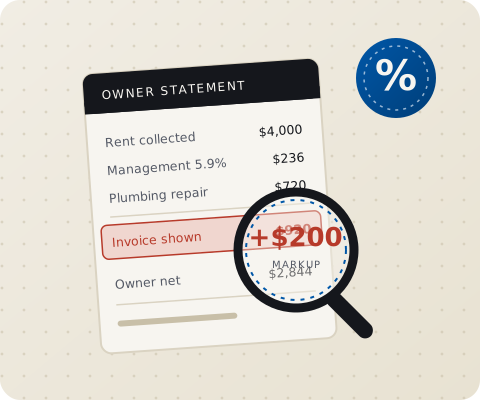
| Maintenance markup reduction (20% → pass-through) | +$840/yr |
| Vacancy reduction: 21 days → 11 days per turnover | +$1,295 per turn |
| Tenant screening upgrade (late-pay and turnover reduction) | ~$400/yr estimated |
| Annual recurring benefit (excl. turnover) | +$6,291 |
+$5,940 — payback in 20 days
Year-one savings less one-time switch cost. Payback on the $351 termination fee: 20 days.
This example is deliberately typical — not the best case. Owners with larger portfolios, more aggressive market-rent upside, or more extreme maintenance markups often see year-one benefits of $10,000–$20,000+ per unit. The common factor: the upside is never just the management fee difference. It’s the stack of rent optimization, maintenance transparency, vacancy reduction, and tenant quality that a better manager delivers.
Your time — the only “soft” cost that matters
Owners often worry about the time cost of switching more than the dollar cost. Here’s the realistic time investment when switching to a quality professional manager.
| Activity | Your time required |
|---|---|
| Initial consultation with new manager | 30–45 minutes |
| Reviewing and signing new management agreement | 20–30 minutes |
| Authorizing termination letter to current manager | 5 minutes (e-sign) |
| Providing access to current owner portal (login/password share) | 5 minutes |
| One brief check-in during transition period | 10–15 minutes |
| Reviewing first NGC owner statement | 10–20 minutes |
| Total owner time investment | 90–120 minutes |
Roughly 90–120 minutes of your attention, spread over 10 business days, for $2,000–$10,000+ of annual benefit. Compared to almost any other financial decision an OC landlord makes, this is one of the highest-ROI time investments available.
The rest is on us
NGC handles the rest: drafting and sending the certified termination letter; coordinating records transfer with your current manager; auditing the received records for completeness; reconciling the security deposit transfer; drafting and sending tenant notification letters (in English and, where applicable, Spanish); onboarding tenants into the NGC portal; validating the rent roll against signed leases; scheduling an in-person property inspection with the assigned property manager; and setting up your AIM owner portal access.
Try it yourself — switching savings calculator
Plug in your current setup and see how much you’d actually save (or lose) by switching managers. Defaults are seeded with a typical OC single-family rental.
Rough estimate — actual savings depend on your property, your current manager, and market conditions. Request a precise free analysis.
Switching cost comparison across common management firms
To put NGC’s no-fee model in context, here’s what common OC property management firms typically charge new owners during onboarding. Specific fees may have changed since last update — verify with each firm directly.
| Firm type | Setup / onboarding fee | First lease-up fee | Monthly fee |
|---|---|---|---|
| National chains (Real Property Mgmt, Renters Warehouse) | $250–$500 | 50–100% of one month’s rent | 8–10% |
| Regional OC firms (typical) | $0–$500 | 50% of one month’s rent | 7–10% |
| Boutique OC firms (2–5 person shops) | $0–$250 | 25–50% of one month’s rent | 6–9% |
| Online / tech platforms (Hemlane, TurboTenant) | $0 | $50–$200 flat | $15–$100 flat |
| NextGen Coastal | $0 | $0 for owners switching | 5.9% |
Look at total annual cost
When comparing firms, look at the total annual cost — monthly management fee + lease-up fee + ancillary charges — not just the headline percentage. A 7% management fee with a 100% lease-up fee and a 20% maintenance markup can end up more expensive than a 9% fee with no lease-up and no markup. Request a sample owner statement from any firm you’re evaluating; transparent firms will provide one without hesitation.
How NGC structures the switching transition
Our standard transition protocol, applied to every owner switching from another manager, takes about 10 business days from signed agreement to first rent collected under NGC:
- Day 0: Owner signs NGC management agreement. Authorization to send termination notice is built in.
- Day 1: NGC drafts and sends certified termination letter to current manager. Simultaneously begins pre-transition audit of existing owner portal data.
- Days 2–4: Current manager acknowledges termination. NGC collects and audits: lease copies, rent roll, security deposit ledger, recent owner statements, maintenance history, vendor contracts, and keys.
- Days 5–6: NGC drafts and sends tenant notification letters (bilingual where applicable) with new payment instructions, portal access, and direct contact information for their assigned property manager.
- Day 7: Physical property inspection by the assigned NGC property manager. Condition documented with photos and added to the property file.
- Days 8–9: Security deposit is reconciled and received from outgoing manager. Any discrepancies are resolved before the transfer is accepted.
- Day 10: First rent payment collected by NGC. Owner’s AIM portal goes live with full property history. First owner statement scheduled for the following month.
Before you sign anything
NGC offers a free transition analysis. We’ll review your current management agreement for termination terms, audit your current fees against our model, estimate your annual savings, and flag any red flags in your current manager’s practices. No obligation to switch — this is a service we provide as an owner-education resource. Request your free transition analysis →
Cost of switching property managers
The questions owners ask most before they pull the trigger on a switch.
Stop paying too much for mediocre management
NGC switches you in 10 business days with zero onboarding fees. Most owners recover the entire switch cost inside the first month.