California Civil Code §1950.5: Security Deposits Explained
Civil Code §1950.5 is the operating manual for California security deposits. It governs how much you can collect, how the money must be held, what it can lawfully be used for, the 21-day move-out accounting requirement, what happens when the property changes ownership or management, and the statutory damages a tenant can pursue when a landlord acts in bad faith. Every California rental owner — whether self-managing or using a firm — needs to know this framework, because the legal exposure runs to the owner regardless of who's holding the funds.
Read the AB 12 deposit cap update →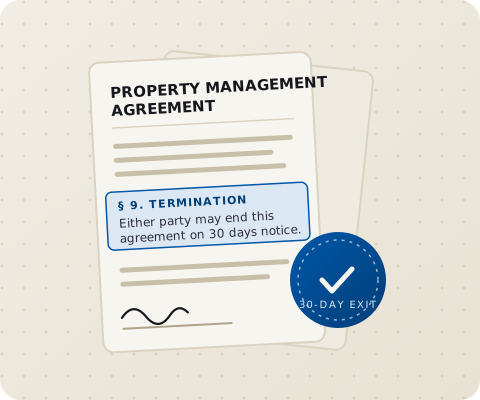
The current deposit cap under AB 12
For most residential tenancies in California, the deposit cap is one month's rent. This is the result of AB 12, signed into law in 2023 and effective July 1, 2024. The change applies regardless of whether the unit is furnished or unfurnished — an important departure from the pre-AB 12 framework that allowed up to two months unfurnished and three months furnished.
A limited small-landlord exception exists. Under AB 12, landlords meeting all of the following criteria may collect up to two months' rent:
- The landlord is a natural person, or an LLC where all members are natural persons
- The landlord owns no more than two residential properties
- Those properties collectively contain no more than four dwelling units offered for rent
Service members under the Servicemembers Civil Relief Act have separate protections that limit the deposit to one month regardless of any small-landlord exception.
For deposits collected before AB 12's effective date, the prior cap structure controls until the tenancy ends. New tenancies and renewals after July 1, 2024 run under the new framework. See the full AB 12 explainer for the transition rules.
Allowable deductions under §1950.5(b)
The statute is narrow about what the deposit can be used for at the end of a tenancy. The enumerated categories:
- Unpaid rent. Includes late fees if the lease provides for them, but only to the extent the lease's late-fee provisions are themselves enforceable.
- Repair of damage caused by the tenant beyond normal wear and tear. The key qualifier is "beyond normal wear and tear." Carpet replacement after a 5-year tenancy is generally normal wear; carpet replacement after pet damage in a 1-year tenancy may not be. Document with photos and vendor invoices.
- Cleaning of the unit upon termination to return it to the same level of cleanliness as at the start of tenancy. Not "professionally cleaned" unless it was professionally cleaned at move-in.
- Restoring or replacing personal property or appurtenances — furniture, keys, garage remotes — if the lease provides for it.
Items not allowed: routine repainting, capital improvements, upgrades, "make-ready" costs that would be needed regardless of tenant conduct, and any deduction for normal wear from a typical tenancy.
The 21-day accounting requirement
This is the timing rule most California landlords violate and most owners get sued over. Within 21 calendar days after the tenant returns possession of the unit, the landlord must either:
- Return the full deposit, or
- Deliver a written itemized statement of deductions along with the remaining balance (if any).
If any single deduction exceeds the statutory documentation threshold (verify current dollar amount in §1950.5(g)(2)), copies of receipts, invoices, or vendor estimates supporting the deduction must accompany the accounting. For work performed by the landlord personally, the statement must include reasonable hours, hourly rate, and a description of the work.
Delivery is by mail to the address provided by the tenant (or last known address) or by personal delivery. Email delivery is allowed only if the tenant has agreed in writing.
Missing the 21-day window doesn't automatically forfeit the deposit, but it severely undermines any defense if the tenant sues. Practically, treat 21 days as a hard deadline. Build the move-out walk-through and the vendor estimates into the timeline so the accounting goes out around day 14, not day 21.
Trust account requirements
For owner-held deposits, §1950.5 doesn't require a specific trust account structure — the funds remain the tenant's property but the owner can hold them in any reasonable form. For deposits held by a property manager acting under a real estate broker license, B&P §10145 layers on additional trust account requirements: separation from operating funds, three-business-day deposit timing, and DRE-auditable records. See property manager mismanaging deposit for the broker-level rules.
Transfer on property sale or manager change
Under §1950.5(h), when ownership changes or when the property manager changes, the deposit must follow the unit:
- The prior holder must either return the deposit directly to the tenant (with the standard accounting if there are pre-transfer deductions), or
- Transfer the deposit to the new owner/manager with written notice to the tenant identifying the new holder and the amount transferred.
Both the prior and new holders share liability to the tenant until the transfer or return is properly completed. The prior firm has no right to hold deposits against alleged unpaid management fees, withholding them from the new manager. If a prior firm stalls on the transfer during a manager change, the sequence is: written demand citing §1950.5(h) by certified mail, 14-day deadline, small claims action if no response. Most disputes resolve at the demand letter.
Statutory damages for bad-faith violations
Civil Code §1950.5(l) provides that when a landlord retains the deposit in bad faith — improperly retaining, fabricating deductions, missing the 21-day accounting, or refusing to return after demand — the tenant may recover:
- Actual damages (the wrongly retained portion of the deposit)
- Statutory damages of up to twice the deposit amount
- Court costs
Small claims court is the standard venue. The current limit on natural-person small claims actions in California is $12,500, which covers the vast majority of deposit disputes. Bad faith is generally established by clear pattern: no accounting delivered, vague deductions without supporting documentation, deposit applied to non-permitted uses (capital improvements, routine repainting), or refusal to respond to written demand.
How §1950.5 applies during a property manager switch
When you change property managers, deposit reconciliation is one of the first records-audit items inside the 30-day switch window. Specifically:
- Confirm the dollar amount held per unit by the prior firm in writing. The amount on the prior firm's books should match the deposit ledger and the amount disclosed to the tenant at lease execution.
- Verify the deposit ledger — any deductions already taken during the tenancy (typically not allowed under most lease structures, but it happens), any interest paid in jurisdictions that require it.
- Audit the deposit transfer mechanics. Funds move from prior firm's trust account to new firm's trust account with written tenant notice meeting §1950.5(h).
- Document the move-in condition report from the start of tenancy. Without it, defending a future deduction is significantly harder.
If there's a shortfall or a missing record, the owner sees it in writing before day 30. The transfer happens during cutover under §1950.5(h). NGC handles the certified-mail tenant notice as part of standard onboarding.
Read the statute directly
The full text of Civil Code §1950.5 is available at the California Legislative Information site: leginfo.legislature.ca.gov. The statute runs several pages and contains additional procedural details (inspection rights, pre-move-out inspections under §1950.5(f), service-member protections) worth reviewing if you self-manage.
Switching managers? We handle §1950.5 reconciliation as part of every transition.
Send us your PMA and current owner statements before the call. We confirm the deposit amounts on file, audit the records for any pre-existing accounting gaps, and tell you whether the transfer mechanics are clean before you sign.
Schedule the call → Or generate the termination letter