California PM fees: normal, negotiable, or refuse.
Every fee category broken out by what’s on the page, what’s in the fine print, and what the OC market actually charges. With a worked dollar example, the maintenance-markup math nobody discloses, and the line items to push back on before you sign.
Where these ranges come from
Drawn from publicly available management company pricing, direct comparison of OC PMAs from owners switching to NGC, and NGC’s position as an active OC management company. Verify against the published fee schedule of any specific firm before relying on this data for a contract decision.
Most California owners sign a property management contract after reading one number: the monthly management percentage. That number is a fraction of what they actually pay over the contract’s life. Leasing fees, renewal fees, maintenance markup, setup charges, inspection fees, and vacancy fees collectively double or triple the effective cost — especially in year one and in any year with tenant turnover.
What follows: every fee category, current OC market ranges for each, a worked dollar example, and the specific charges that should make you walk away from a contract before signing.
All fee types at a glance
Property management fees fall into nine distinct categories. Not all companies charge all of them, and the amounts vary substantially. Here is the full picture of what exists in the market.
Monthly management fee
Charged on gross collected rent each month. This is the core fee and the one advertised most prominently. Lower percentage does not always mean lower total cost — see below.
OC avg: 7–10% SFRLeasing / placement fee
Charged once when a new tenant is placed. Some companies charge a flat fee; others charge a percentage. On a $3,200/mo unit, this is $1,600–$3,200 per new lease.
NGC: flat $495Lease renewal fee
Charged when an existing tenant renews for another term. Most companies charge this annually. Some charge it even when the tenancy auto-renews month-to-month.
NGC: $150Maintenance markup
A coordination surcharge added on top of vendor invoices. When present, it creates a structural incentive to use more expensive vendors. The best managers charge nothing.
NGC: $0 markupSetup / onboarding fee
One-time charge when you start with a new manager. Theoretically covers listing photos, initial property documentation, and trust account setup. Often charged regardless of whether the property is vacant or occupied.
NGC: $0Annual inspection fee
Charged for periodic property inspections during a tenancy. Some companies charge per inspection; others include it in the management fee. Inspections are genuinely valuable — verify they are actually performed.
Should be in mgmt feeEviction coordination fee
Charged for coordinating the eviction process, separate from attorney fees. A reasonable coordination fee is $500–$750 for the administrative work involved. Fees above $1,000 for coordination alone are excessive.
Attorney fees are separateVacancy fee
Some managers charge a reduced fee during vacant months rather than zero. This is a red flag — it reduces the manager’s financial incentive to fill the vacancy quickly.
Red flag — refuse thisEarly termination fee
Charged if you exit the management contract before its term ends. Ranges from zero (best-in-class) to 2–3 months of management fees or a flat penalty. A termination fee is always a red flag about management confidence.
NGC: $0The monthly management fee in depth
The monthly management fee is the most significant ongoing cost of professional property management, and it contains several nuances that affect how much you actually pay versus what the advertised rate suggests.
How the fee is calculated
The industry standard is to calculate the management fee on gross collected rent — the actual rent received from the tenant in a given month — not on stated or scheduled rent. This means you pay zero management fee during a vacant month at a well-run company. However, some contracts specify the fee on “stated rent” or “scheduled rent,” which means you continue paying even when the unit produces no income. Always verify this distinction in the contract language before signing.
OC market rates by property type
In Orange County, management fee percentages vary somewhat by property type and portfolio size. Single-family rentals (SFR) and condos generally command the highest rates because they require the same operational work as larger properties but produce less total rent per unit. Larger multifamily portfolios benefit from economies of scale.
- SFR and condo (1 unit): 7–10% is the OC market range; 8–9% is most common
- Small multifamily (2–4 units): 7–9% depending on property characteristics
- Larger multifamily (5+ units): 6–9%, with lower rates possible for larger portfolios
- NextGen Coastal: Averages 5.9% across the OC portfolio regardless of property type
Flat fee vs. percentage: pros and cons
A small number of management companies offer a flat monthly fee (for example, $150–$250/month) rather than a percentage. Flat fees benefit owners with higher-rent properties — a $200/month flat fee on a $4,000/month rental is 5%, well below market rate. They disadvantage owners with lower-rent properties — the same $200/month flat on an $1,800/month unit is 11%.
The most common hidden trap
“8% of monthly rent” sounds identical whether it means collected rent or stated rent — but they are very different when a tenant pays late, pays partial rent, or the unit is vacant. Always read: “8% of gross collected rent” (acceptable) vs. “8% of monthly rental rate” (red flag).
Hidden fees to watch for
Several fee structures in property management are technically disclosed — often buried in contract addenda — but function in practice as hidden costs because they are not included in any comparison most landlords make when evaluating a manager.
-
!
Maintenance markup: 10–15% on top of every invoice
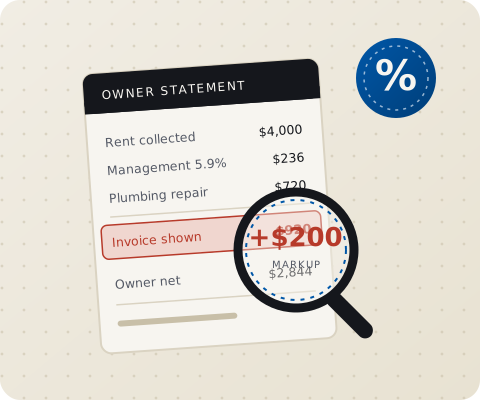
A manager charging a 10% coordination markup on $6,000 in annual maintenance work adds $600 in fees that never appear in the management fee line. At 15%, that is $900/year. More importantly, this markup creates an incentive to assign more expensive vendors to any job — a structural conflict of interest with the owner. Ask directly: “Does your company charge a maintenance coordination markup or vendor surcharge?” If the answer is yes, get the exact percentage in writing before signing.
-
!
Late payment fees retained by the PM, not credited to owner
When a tenant pays rent late, they typically owe a late fee — commonly $50–$100 or 5–10% of monthly rent. In many management contracts, this late fee is retained entirely by the management company rather than credited to the owner whose rent was late. The owner suffered the cash flow impact of the delay; the manager profits from it. Verify in your management agreement who retains late payment fees.
-
!
Month-to-month renewals treated as new placements
Some management companies treat a lease that converts to month-to-month tenancy — rather than a signed annual renewal — as a new placement event triggering a leasing fee. If your tenant has been in place for three years but happens to be on a month-to-month lease, you should not be paying a new tenant placement fee every 12 months. Read the contract definition of “placement” and “renewal” carefully.
-
!
“Compliance inspection” bill-backs
Some management companies bill back the cost of “compliance inspections” as a separate line item on owner statements, in addition to the management fee. These inspections — which may or may not actually occur — are a service that should be included in the management fee, not billed as an extra. We have seen owners charged $75–$150 per visit, multiple times per year, with minimal or no documentation that the inspection occurred. Request photo evidence and a written report for every billed inspection.
-
!
Excessive eviction coordination fees
When a tenant must be evicted, the management company coordinates the process with an attorney. A reasonable coordination fee for this administrative work is $500–$750. Some companies charge $1,500–$2,000 for coordination alone — before attorney fees, filing costs, and lockout fees are added. Evictions are already expensive; excessive coordination markups make them significantly more so.
OC market comparison: low, typical, and NGC
Here is a direct comparison of each major fee category across the OC market spectrum.
| Fee type | OC low end | OC typical | NextGen Coastal |
|---|---|---|---|
| Monthly management fee | 7% | 9% | 5.9% avg |
| Leasing / placement fee | 50% 1st mo. | 75–100% 1st mo. | Flat $495 |
| Lease renewal fee | $150 | $250 | $150 |
| Setup / onboarding fee | $0 | $299 | $0 |
| Maintenance markup | 0% | 10% | 0% |
| Vacancy fee | $0 | Varies | $0 |
| Early termination fee | $0 | $500 | $0 |
How to calculate your total annual cost
The monthly management percentage tells you almost nothing about your true annual cost. Here is how to calculate what you will actually pay in year one and year two, using a realistic OC property scenario.
Scenario: $3,500/month rent, one tenant turnover in Year 1, one renewal in Year 2 (no turnover).
Year 1 — new tenant placed
| Line item | OC typical (9% + 100%) | OC low (7% + 50%) | NextGen Coastal |
|---|---|---|---|
| Management fee (12 mo × $3,500) | $3,780 | $2,940 | $2,478 |
| Leasing fee | $3,500 | $1,750 | $495 |
| Setup fee | $299 | $0 | $0 |
| Maintenance markup (on ~$3,000 work) | $300 | $0 | $0 |
| Total Year 1 | $7,879 | $4,690 | $2,973 |
Year 2 — tenant renews (no turnover)
| Line item | OC typical (9% + $250) | OC low (7% + $150) | NextGen Coastal |
|---|---|---|---|
| Management fee (12 mo × $3,500) | $3,780 | $2,940 | $2,478 |
| Lease renewal fee | $250 | $150 | $150 |
| Maintenance markup (on ~$2,000 work) | $200 | $0 | $0 |
| Total Year 2 | $4,230 | $3,090 | $2,628 |
About $6,500 over two years
On this $3,500/month OC property with one turnover in Year 1 and one renewal in Year 2: OC Typical total = $12,109. OC Low total = $7,780. NextGen Coastal total = $5,601. The difference between typical OC management and NGC is approximately $6,500 over two years on a single property.
Fees that are red flags — refuse these
Some fee structures are so contrary to the owner’s financial interest that accepting them is rarely justified. These are the charges to refuse when evaluating a property management contract.
- Setup fee above $300 when the property already has a tenant. If a tenant is in place, the onboarding work is minimal — records transfer, trust account setup, tenant notification. Charging $400–$500 for this is disproportionate. The market norm for in-place tenants is $0–$150.
- Maintenance markup above 10%. Any markup above 10% on vendor invoices is above the high end of the market range and creates too strong an incentive to favor expensive vendors. The acceptable range, when a markup is charged at all, is 0–10%. Best practice is zero.
- Vacancy fee (charged during months the unit produces no income). A management fee on a vacant unit charges you for a month when you received nothing. This structure reduces the manager’s incentive to fill the vacancy promptly. Any fee — even a “reduced” 25–50% vacancy fee — is a red flag.
- Non-refundable onboarding deposit. Some companies require a non-refundable upfront deposit in addition to or instead of a setup fee. If the company provides poor service in the first 30–60 days, a non-refundable deposit removes your ability to recover any money when you leave.
- Termination fee above one month’s management. Termination fees should be $0 at best-in-class companies. A fee representing more than one month of management fees is a significant barrier to switching if performance is poor — which is exactly how some companies structure it intentionally.
9% can really mean 15–18%
When multiple red-flag fee structures exist in the same contract — a vacancy fee, a maintenance markup, a high leasing fee, and a termination penalty — they compound. A company that charges 9% plus a vacancy fee plus 15% maintenance markup plus $3,500 leasing fee plus a $1,000 termination penalty is not offering 9% management. It is offering something closer to 15–18% management in years with tenant turnover, with a penalty for leaving.
How to evaluate a management fee proposal
When you receive a fee proposal from a property management company, ask for all of the following in writing before signing:
- The monthly management percentage — and whether it is calculated on collected or stated rent
- The leasing fee — exact amount or percentage, and the definition of what triggers it
- The lease renewal fee — exact dollar amount, and whether month-to-month continuation triggers it
- Maintenance markup policy — exact percentage or zero, and whether it applies to all vendors
- Setup or onboarding fee — exact amount, and whether it differs for occupied vs. vacant properties
- Vacancy fee policy — whether any fee is charged during vacant months
- Termination clause — notice period required and exact termination penalty if any
- Late fee retention — who keeps tenant late fees, owner or manager
A management company that resists providing clear written answers to any of these questions before signing is telling you something important about how transparent they intend to be after you are locked into the agreement.
Frequently asked questions
What Orange County owners ask most about property management fees.
See exactly what NGC would cost for your property
Get a detailed fee proposal and comparison against what you’re currently paying — or what you’re being quoted. No obligation, 24-hour turnaround.