Self-manage or hire a property manager? The honest comparison.
The decision turns on four variables — time, proximity to the unit, portfolio size, and your appetite for California tenant-law exposure. Below is the real math on both sides, plus the OC-specific cost figures most online calculators leave out.
Not “hire or not”
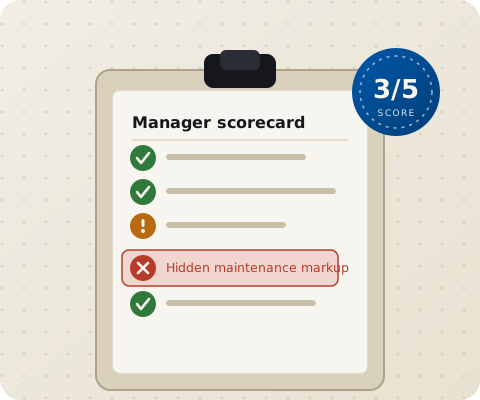
It’s “self-manage or hire a good manager.” A bad PM is worse than self-managing — they add their fees on top of the costs they fail to control.
Every California owner eventually asks: should I keep managing this myself, or hire someone? There is no universal answer. The decision turns on how many units you have, how far you live from them, how much your time is actually worth at the margin, and whether you have the background to navigate California’s tenant-law landscape, which changes every legislative session.
Two consistent patterns: owners who self-manage almost always underestimate the time cost, and owners who hire a property manager almost always underestimate the variation in quality between firms. The page below addresses both directly.
Read the cost math, then find your profile
Read through the cost breakdowns for both options, review the comparison table, then check the “When it makes sense” sections to see which profile fits you. If you decide to hire, the final section tells you what specifically to look for so you don’t end up with a manager that’s worse than handling it yourself.
The real cost of self-managing
Self-managing looks free on the surface — no management fee, no leasing fee. But the actual cost of doing it yourself is real, and most landlords calculate it incorrectly because they either omit their own time or value it at zero.
Time: 8–12 hours per month, per property
Average self-managing landlords spend 8–12 hours per month per property on advertising vacancies, coordinating showings, screening applicants, handling maintenance calls and scheduling vendors, collecting and tracking rent, responding to tenant requests, and reconciling accounts. This estimate is conservative — it rises significantly during vacancies or tenant disputes.
8–12 hrs/mo at $50/hr = $400–$600/moLegal exposure: CA tenant law is unforgiving
California has among the most complex residential landlord-tenant laws in the country. AB 1482 governs rent increases on qualifying properties. AB 12 (effective July 2024) limits security deposits to one month’s rent for most units. SB 567 expanded just-cause eviction protections. Habitability standards under Civil Code §1941 are strictly enforced. A single lease that doesn’t reflect current law or a security deposit handled incorrectly can result in statutory penalties, forced deposit return, and legal fees that dwarf any management cost savings.
One mistake can cost $1,000–$5,000+Vacancy cost: 2–3 weeks longer without pro marketing
Independent landlords without professional marketing systems and active rental platforms typically experience vacancies that run 2–3 weeks longer than properties managed by an active leasing operation. On a $2,800/month OC rental, each additional week of vacancy costs approximately $645 in lost rent. That gap alone can erase the annual management fee savings for many owners.
$645/wk on a $2,800/mo unitEmergency response: the 2 AM problem
When a pipe bursts at 11:30 PM on a Saturday or a tenant is locked out on a holiday, the call comes to you. Finding a licensed, reasonably priced contractor for emergency after-hours work — when you don’t have a vendor network — typically costs 40–80% more than a managed property where the PM has pre-negotiated vendor rates. Beyond the cost, the availability burden falls entirely on the owner.
Emergency markups: 40–80% above normalNone of this shows on a statement
None of these costs appear as a line item on any monthly statement. Time, legal risk, extended vacancy, and emergency premiums are invisible costs — which is exactly why self-managing landlords consistently underestimate what the DIY approach is actually costing them each year.
The real cost of hiring a property manager
Hiring a property manager is not simply paying a percentage of your rent. The true cost involves understanding the full fee structure, including charges that are not in the headline number. Here’s what you’re actually paying for — and how the math looks at current OC rates.
Monthly management fee: 7–10% in Orange County
The monthly management fee in Orange County typically runs 7–10% of gross collected rent for single-family and small multifamily properties. On a $3,200/month rental at 9%, that is $288/month or $3,456/year. The fee is charged on collected rent, not stated rent — so you are not paying for months the unit is vacant at most reputable companies.
Leasing fee: 50–100% of first month’s rent
Most management companies charge a separate leasing or placement fee whenever a new tenant is placed. In OC, this typically ranges from 50–100% of one month’s rent. On a $3,200/month unit, that is $1,600–$3,200 per new tenant placement. NextGen Coastal charges a flat $495 leasing fee regardless of rent amount — a significant difference at higher rent levels.
The break-even calculation
Here is a straightforward break-even framework. If your time is worth $50/hour and self-managing requires 10 hours per month, you are absorbing $500/month in opportunity cost. A 9% management fee on a $3,200/month rental is $288/month. In this scenario, the management fee is already cheaper than your time — before accounting for vacancy reduction, legal protection, or emergency vendor access.
A bad PM is worse than self-managing
A manager who charges maintenance markups, delays owner payouts, uses outdated lease templates, or ignores rent increases does not protect you from these costs — they add their fees on top. The decision is not “self-manage or hire” — it is “self-manage or hire a good manager.” That distinction is the entire reason this site exists.
The three scenarios compared
Here is how self-managing, a typical OC property manager, and NextGen Coastal compare across the variables that matter most to your net income and peace of mind.
| Factor | Self-manage | Typical PM | NextGen Coastal |
|---|---|---|---|
| Monthly management fee | $0 | 8–10% | 5.9% avg |
| Leasing fee | $0 | 50–100% 1st mo. | Flat $495 |
| Legal compliance | Your risk | Shared | Covered |
| Maintenance markup | At cost | 10–15% | $0 markup |
| Owner portal | Manual | Varies | Real-time |
| Owner payout timing | Immediate | 15–30 days | 1–3 business days |
| 24/7 emergency response | You | Maybe | Yes |
| Termination fee | — | $250–$1,000 | $0 |
When self-managing makes sense
Self-management is a legitimate choice for a specific profile of landlord. If most of the following apply to you, the DIY approach may be the right one — at least for now.
- ✓You live within 15 minutes of the property and can reach it quickly
- ✓You own fewer than 3 rental units total
- ✓You have a construction, maintenance, or property background
- ✓You can reliably dedicate 10+ hours per month per property
- ✓You genuinely enjoy the landlord work and find it manageable
- ✓You have or are willing to acquire working knowledge of California tenant law
- ✓You have established relationships with reliable, licensed contractors
- ✓You are available for after-hours maintenance emergencies
Have your lease reviewed annually
Even if you currently self-manage successfully, California’s landlord-tenant law changes frequently — AB 1482, AB 12, SB 567, and local rent ordinances all require ongoing attention. Many landlords who are confident self-managers on the operational side are unknowingly using outdated leases or non-compliant deposit procedures. At minimum, have your lease template reviewed by a California landlord-tenant attorney annually.
When hiring a property manager makes sense
For the majority of California rental property owners, professional management produces a better financial outcome and a substantially lower stress load. Consider hiring if any of the following describe your situation.
- ✓You own more than 3 rental units and coordination is becoming complex
- ✓You live more than 30 minutes from the property
- ✓You have a full-time job, business, or other primary time commitment
- ✓You want truly passive income without operational obligations
- ✓You have experienced tenant issues, disputes, or non-payment
- ✓You are not current on California AB 1482 / AB 12 / SB 567 compliance
- ✓Your vacancy periods have been running longer than 25 days
- ✓You are growing your portfolio and the workload is not scaling well
What matters most
Not all property managers are equal. A below-average manager costs you more than self-managing. Here are the five criteria that separate genuinely good management from average or below-average.
DRE license verification
Any California property manager charging a fee must hold a valid DRE broker license. Verify at bre.ca.gov before signing anything. An expired or suspended license means their contracts may be unenforceable.
No maintenance markup
The most common hidden fee in property management is a 10–15% markup on vendor invoices. Ask directly whether the company charges a maintenance coordination markup. The best managers — like NGC — charge zero.
Real-time owner portal
You should be able to see maintenance work orders, rent collection status, inspection reports, and financial statements without waiting for a monthly report. If the company cannot show you a live demo of their owner portal, that gap will cost you visibility and responsiveness.
Fast owner payouts: 1–3 days
Many OC management companies hold owner funds for 15–30 days after collecting rent. That float is an interest-free loan of your money. Insist on a company that disburses to owners within 1–3 business days of rent collection.
No termination fee
A manager who is confident in their service does not need a termination penalty to keep your business. If the contract includes a termination fee above $0, it is a signal about their confidence in their own performance — and a financial barrier to switching if things go wrong.
DRE-licensed, $0 markup, $0 termination fee
NGC is DRE-licensed, charges zero maintenance markup, provides a real-time AIM owner portal, disburses owner funds within 1–3 business days, and has a $0 termination fee. Average management fee across the OC portfolio: 5.9%.
Frequently asked questions
The questions California owners ask before deciding between self-managing and hiring.
Ready to compare NGC to what you’re paying now?
Get a fee comparison and free proposal in 24 hours. No obligation. We’ll review your current situation and tell you honestly whether switching makes financial sense for your portfolio.