23 interview questions for a property manager — with what a real answer sounds like.
Every question you need across five categories, with the answer a good manager gives and the dodge that should end the conversation.
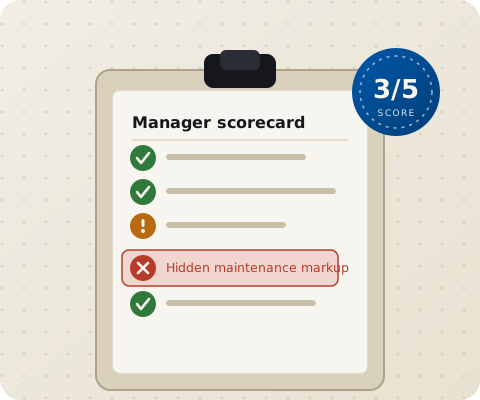
Score every answer
2 points for a strong answer, 1 for partial, 0 for a red flag. Ask every question at every interview, then use the scorecard to compare. Max score: 46 points.
Most owners interview one or two firms and pick whichever one seemed most professional. That’s not an evaluation; it’s a guess. Real comparison needs the same questions asked of every candidate so the patterns become visible. The 23 questions below give you that — organized by category, with what a strong answer sounds like and which responses should end the consideration.
Interview at least three firms. With two, you don’t have enough comparison data to recognize an evasive answer or an unusual contract term. With three, patterns emerge: which firm produces a sample owner statement on the spot, which one answers the DRE license question without flinching, which one becomes vague when asked about the maintenance markup.
Print it, score it, compare it
Print or save this page. Ask every question at every interview. Score each answer: 2 points for a strong answer matching the “Good answer” description, 1 point for a partially adequate response, and 0 for a red-flag answer. Use the scoring guide at the bottom to interpret totals. A candidate who cannot answer these questions clearly is not ready to manage your asset.
Fees & financial transparency
Financial transparency is the foundation of the entire management relationship. A manager who cannot answer these questions directly — or who resists putting answers in writing — is telling you something important about how your money will be handled.
What is your monthly management fee and exactly how is it calculated?
“X% of collected rent.” Collected rent means you only pay the management fee when the tenant actually pays — not when rent is owed. This aligns the manager’s financial incentive with yours. They should state the percentage clearly and confirm it applies to collected amounts.
“X% of stated rent” or “X% of market rent.” This means you owe the management fee even when the tenant doesn’t pay, during vacancies with any minimum fee applied, or on rent amounts above what was actually collected. Alternatively: “It depends” without specific numbers, or reluctance to commit anything in writing.
What other fees do you charge beyond the monthly management fee?
A clear, complete list — leasing/placement fee (e.g., 50–75% of one month’s rent), lease renewal fee or $0, inspection fees if charged, and nothing else. Specific dollar amounts or percentages for each line item. They should offer to provide this in writing before you leave.
“There may be some administrative fees” or “we only charge for what’s in the agreement.” Vagueness here is a pattern, not an oversight. Every legitimate fee should be named and quantified on the spot. Any fee not named in the interview will be a surprise on your first statement.
Do you mark up maintenance invoices?
“No. We pass vendor invoices through at cost and provide you the original vendor invoice.” Ideally they add: “You can verify any charge by requesting the supporting invoice at any time.” This is how transparent managers operate.
“We add a small coordination fee” or “there’s a 10% handling charge.” Maintenance markups of 10–15% on every repair add up quickly — on a $5,000 HVAC repair, that is $500–$750 extra that goes to the management company, not your property. This is a significant hidden cost that a low management percentage often obscures.
When do you pay owners and how?
ACH (direct deposit) within 1–3 business days of rent collection. The faster, the better. A manager who pays out within 1–2 days has their trust accounting organized and automated. Ask what platform they use — AppFolio, Buildium, Rent Manager, and similar platforms support fast automated distributions.
“Around the 15th” or “after we reconcile the books” or “typically by the end of the month.” These answers describe managers who are either disorganized, using your funds as a float, or operating on a manual reconciliation process. On a $4,000/month property, a 25-day payout delay vs. a 3-day delay is a meaningful cash flow difference every month.
Can I see a sample owner statement?
They hand one over immediately — printed or on a screen — and walk you through the line items: gross rent collected, management fee, individual maintenance charges with vendor names, reserve balance, and net distribution. A statement you can understand without explanation is a sign of good operations.
Hesitation, “I don’t have one with me,” “we can email it later,” or a statement so dense with codes and abbreviations that it requires explanation. If you cannot read your own financial statement, monitoring your property’s performance becomes dependent on trusting the manager — which is a weak position.
Is there an early termination fee in your contract?
“No. You can terminate with 30 days written notice at any time, for any reason, with no penalty.” Or: “$0 if you give proper 30-day notice.” A manager confident in their service does not need to lock you in with a financial penalty.
“We charge 2–3 months of management fees if you leave early” or “termination is tied to the lease anniversary” or “at our discretion.” Early termination penalties trap you in underperforming relationships. Any penalty that is not zero or a trivial notice period cost should be negotiated out before signing.
Tenant screening & leasing
Bad tenant placement is the single most expensive outcome in property management — worse than a vacancy. Evictions in California now routinely take 3–6 months and cost $5,000–$15,000 in legal fees, lost rent, and property damage. These questions verify the manager’s screening process is rigorous enough to avoid that outcome.
What is your tenant screening process?
Full credit report (score threshold stated), income verification at 2.5–3x monthly rent, eviction history check (not just court records — a dedicated eviction database), criminal background check, and prior landlord references actually called. Each element should be stated specifically.
“We run a credit check.” One component is not a screening process. The most problematic tenants often have acceptable credit but a history of evictions, undisclosed prior landlord disputes, or income that is seasonal or unverifiable. Incomplete screening is the leading cause of bad placements.
What is your current vacancy rate across your portfolio?
Under 2% for the Orange County market. This is an achievable benchmark in a well-managed portfolio. They should be able to state this figure from memory or produce it quickly from their management software.
“I’d have to check” or evasiveness about the number, or a rate over 4–5% without a compelling explanation (e.g., recent portfolio acquisition of distressed properties). Vacancy rate is a basic operational metric — a manager who does not track it is not data-driven.
How long does it typically take to place a tenant in Orange County?
2–4 weeks for a market-priced single-family rental in the OC market. They should cite a specific average days-on-market figure from their recent portfolio — not a range based on assumptions. This shows they track performance and understand local conditions.
“It varies a lot” or “it depends on the property” without providing a baseline benchmark. Every manager will have properties that vary — but a well-run company knows their average and can state it. Inability to provide a number means they are not tracking or not willing to be accountable to one.
How do you handle lease violations?
A documented escalation protocol: written warning to tenant with cure deadline → if uncured, formal 3-day notice to perform or quit (served correctly under CCP §1161) → if unresolved, eviction referral to a California unlawful detainer attorney. Every step is written, documented, and communicated to the owner.
“We call the tenant” or “we try to work it out first.” Informal resolution has no legal standing in an unlawful detainer action. If the manager’s lease violation process relies primarily on verbal communication, you will be disadvantaged in any court proceeding. California’s notice requirements are strict — only written, properly served notices protect your rights.
Do you use the California Association of Realtors lease form?
Yes — the CAR Residential Lease Agreement (Form RLA) or the CAR Long-term Lease form updated for current California law including AB 1482, AB 12, and SB 567. If they use an alternative, they should explain clearly what form they use, who drafted it, and when it was last reviewed by a California real estate attorney.
A proprietary lease the management company wrote themselves without any attorney review or CAR endorsement. Homegrown leases often lack the California-required disclosures (Megan’s Law, pest and mold, lead paint, rent control eligibility) and create legal exposure for owners even when the violations are the manager’s fault.
Maintenance & property care
Deferred and mismanaged maintenance is a major source of owner losses — both through property deterioration and through liability exposure when habitability issues go unaddressed. These questions evaluate whether the manager has a professional vendor network and a disciplined approval process.
Who are your preferred vendors and can you provide references for them?
Named vendors for each trade category (plumbing, HVAC, electrical, general repair) that they use consistently. They should be able to confirm those vendors are licensed (CSLB) and insured, and should be willing to share vendor contact information if you want to verify. Long-term vendor relationships typically mean faster response times and competitive pricing.
“We use whoever is available” or “we use a marketplace platform” without a core preferred vendor list. Rotating through one-time vendors means no accountability, no relationship leverage, and no service history. It also often means higher prices and slower response times for anything beyond routine repairs.
What is your process for approving maintenance over a certain dollar threshold?
Owner approval required in writing for any non-emergency repair over a specified threshold — typically $250–$500. They should be able to state the threshold immediately. Emergency repairs (water intrusion, no heat, safety issues) may have a higher threshold or automatic approval to comply with California habitability law, but those exceptions should be defined.
No defined threshold, or a threshold set at $1,000 or higher without explaining the emergency carve-out. “We handle minor stuff without bothering you” is a red flag — even a $600 repair authorization without your knowledge represents money leaving your account without your approval.
Do you conduct regular property inspections?
Move-in inspection with photos, move-out inspection with photos, and at least one annual interior inspection with a written report delivered to the owner. Some managers include a mid-lease drive-by inspection as well. The key requirements: written reports, photos, and delivery to the owner.
“We inspect when there’s a reason to” or “we do move-in and move-out.” No regular interior inspection means deferred maintenance accumulates invisibly, lease violations go undetected, and you have no documentation to support a deposit claim if the tenant disputes damage at move-out.
How do you handle maintenance emergencies at 2am?
A 24/7 emergency line staffed by or routed to a property manager or on-call manager — not just an answering service. The manager (not the tenant) contacts the appropriate vendor, authorizes the repair, and documents everything. The owner is notified the next business morning with a full incident summary.
“Tenants reach the vendor directly” or “we have an on-call vendor list tenants can call.” When tenants contact vendors directly, the manager is out of the loop — there is no documentation, no authorization oversight, and no way to control costs or confirm the work was actually necessary.
Can I choose my own vendors?
Yes, as long as the vendor is licensed (CSLB) and carries appropriate insurance. Some managers ask that you introduce the vendor first so they can confirm compliance — this is reasonable. Owner-preferred vendors are often family tradespeople or established relationships with proven quality and pricing.
“We only use our approved vendor list” or “we can’t guarantee quality if you use your own vendors.” Exclusivity requirements for your own vendor list often indicate that the manager has financial relationships with their preferred vendors — referral fees, kickbacks, or ownership interests. This conflicts directly with your interest in cost-effective repairs.
Communication & reporting
Poor communication is the most commonly cited complaint against property managers — and it is almost always a symptom of operational structure problems, not personality. These questions evaluate whether the manager has systems that support proactive owner communication.
Do you have a real-time owner portal?
Yes, accessible 24/7 through a web browser or mobile app, with real-time financial transactions, work order status, inspection reports and photos, lease documents, and rent payment history. They should offer to show you a demo on the spot. AppFolio, Buildium, Rent Manager, and similar platforms support this functionality.
Monthly PDF statements emailed to you, “we’ll set up portal access when you sign,” or a portal that only shows transactions — not maintenance status or inspection records. Monthly-only reporting means you are always at least 30 days behind on what is happening at your property.
How quickly do you respond to owner inquiries?
Same business day for routine inquiries — same hour for urgent matters. They should have a stated SLA (service level agreement) for owner communication and be willing to put it in writing. “You’ll have my personal cell and I answer same day” is also acceptable from a smaller boutique manager.
“Within 2–3 business days” as a standard response time. For a professional managing your most significant asset, 48–72 hours for a routine owner question is too slow. It suggests either an understaffed operation, or a culture where owner inquiries are low priority relative to tenant issues.
Will I have a dedicated point of contact?
A named property manager who handles your portfolio and is your primary contact for all communications. When that person is unavailable, there is a clearly named backup. You should know exactly who to call and have their direct contact information.
“Whoever is available” or “our team handles inquiries” or routing everything through a general inbox. Team models without dedicated contacts mean every interaction requires re-explaining your situation, questions fall through the cracks, and no one owns accountability for your specific portfolio’s performance.
How do you communicate lease renewals and rent adjustments?
60-day advance notice to the owner with a written recommendation including current market data for the area and comparable rents. The owner approves or modifies the recommendation before the manager proceeds. For rent increases, they should explain how they stay within AB 1482 caps and local rent control ordinances where applicable.
“We auto-renew at the current rate” or “we handle renewals and notify you after.” Auto-renewal without owner consultation means you may be missing market rate increases or accepting a tenant renewal at below-market rent. Rent decisions made without your input remove you from one of the most consequential financial decisions about your property.
Company background & licensing
These questions verify the basic credentials every California property manager is legally required to hold, and assess whether the company has the local experience depth to operate effectively in the Orange County market.
Is your company licensed with the California DRE?
The broker license number, stated immediately from memory. They may offer to pull it up on bre.ca.gov right in front of you, which is an excellent sign. The license type should be Broker — not Salesperson. Bonus: they know their expiration date and can confirm there are no pending disciplinary actions.
“I think so” or “my partner handles the licensing” or an inability to state the license number. California Business & Professions Code §10131 requires a real estate broker license to manage property for compensation. A manager who cannot immediately confirm their license number either does not have one or does not monitor their own compliance.
How long have you been managing properties in Orange County?
5+ years in the OC market specifically, with the ability to name neighborhoods, discuss local vacancy trends, and reference relationships with local vendors and contractors. OC market knowledge — rent ranges by city, local HOA dynamics, beach-area tenant profiles — is built over years and cannot be replicated from a national playbook.
Less than 2 years in the OC market, heavy reliance on national corporate systems without local vendor relationships, or a manager who cannot name the cities they operate in with any specificity. A new entrant to OC property management will use your property to build the experience they do not yet have.
How many properties does each of your managers oversee?
30–50 properties per manager is a healthy, attentive ratio that allows genuine engagement with each owner and property. Some highly organized managers can handle up to 60–70 with good software systems. These numbers allow the manager to actually know what is happening at each property.
“I’m not sure exactly” (disqualifying — this is a basic operational metric they should know instantly) or a ratio above 100+ per manager. At 100 properties per manager, each property receives an average of less than 5 minutes of active manager attention per week. That is not property management — it is reactive triage.
Scoring your interview results
Score each answer: 2 points for an answer that matches the Good answer description, 1 point for a partially adequate answer, 0 points for a red-flag answer. Maximum score: 46 points.
Compare scores across all candidates. If your top scorer is below 38, expand your candidate pool before signing. The Orange County market has enough management companies that a score of 38+ should be achievable with 4–5 interviews.
Three pass/fail questions
Three questions are automatic disqualifiers regardless of the total score: Question 21 (DRE license — a manager without an active broker license cannot legally manage your property); Question 1 (collected vs. stated rent — “stated rent” fee structures impose fees you never agreed to pay); and Question 15 (24/7 emergency coverage — no emergency protocol means your tenant’s 2am pipe burst will go unmanaged until business hours). These are not scoring questions. They are pass/fail.
Pair this with the full framework
Once you have scored your candidates, read the full evaluation framework on the How to Choose a Property Manager page for DRE license verification steps, insurance requirements, and management contract terms to compare. Choosing the right manager is a process — the interview is one step, not the last one.
Frequently asked questions
Quick answers about interviewing property managers.
Ready to evaluate NGC with these questions?
We’ll answer every question on this list in writing before you sign anything. And if you interview us alongside other managers, we’ll help you understand what to look for in their answers too.