The PM early termination fee: what’s enforceable, what isn’t.
Most California landlords don’t realize how negotiable these fees actually are, or how often they’re unenforceable under Civil Code §1671(b) when challenged. The fee on the page is rarely the fee you’d pay if you fought it.
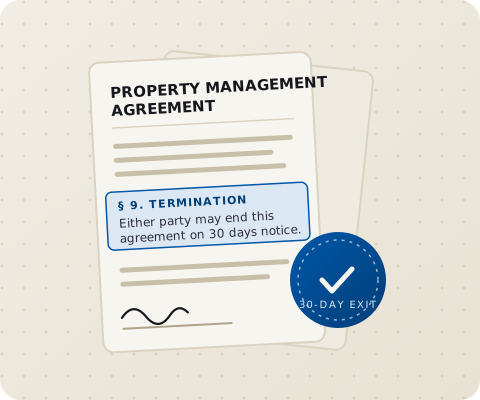
NGC charges $0
NextGen Coastal does not charge any early termination fee. Owners exit with 30 days written notice at any time, for any reason. Retention should come from performance, not contractual lock-in.
The early termination fee is the single biggest thing that keeps unhappy California owners stuck with an underperforming property manager. On paper it sounds intimidating. In practice, it’s frequently unenforceable, often negotiable, and sometimes entirely avoidable — if you know how the fee works before you need the knowledge.
What follows: how the fee is typically structured, when California courts uphold it and when they don’t, and the exit grounds that bypass it entirely.
What is an early termination fee?
An early termination fee is a charge assessed by a property manager when an owner cancels the management agreement before the contract’s natural expiration or outside the contract’s permitted notice window. It is not a fee for switching property managers — it only applies when you exit outside the rules your contract allows.
Two types of early termination fees
California property management contracts typically use one of two structures:
- Flat fee: A fixed dollar amount ($250–$3,000) stated in the contract. Simple, predictable, and usually the easier type to negotiate down.
- Liquidated damages: A formula-based amount, typically 2–3 months of management fees (e.g., 2 months × $180/month = $360). Courts apply stricter scrutiny to these under California Civil Code §1671(b).
What triggers the fee
The fee is triggered by terminating outside the contract’s permitted exit mechanism — not by switching managers per se. If your contract says you can terminate with 30 days written notice at any time, you can switch managers without triggering any fee. The fee only kicks in if you terminate mid-term without the required notice, or in a contract that has no at-will termination right.
The once-a-year exit trap
Some contracts only allow termination during a specific 30-day window each year (e.g., within 30 days of the contract anniversary). Miss the window and you are locked in for another full year. This is an aggressive contract structure — negotiate it out before signing, or avoid the company entirely.
Are early termination fees enforceable in California?
California courts will uphold early termination fees that function as legitimate liquidated damages — that is, a reasonable pre-estimate of the PM’s actual losses from losing a management account. Courts will refuse to enforce fees that function as penalties — punitive amounts designed to trap rather than compensate.
The California standard: Civil Code §1671(b)
Under California Civil Code §1671(b), a liquidated damages clause in a contract that is not primarily for personal services is valid unless the party seeking to avoid it proves the clause was unreasonable under the circumstances existing at the time of contracting. The practical effect: a PM’s actual losses from losing one management account are typically 1–2 months of management fees. A fee of 6–12 months is almost certainly a penalty, not compensation.
When courts have voided termination fees
- Fee grossly disproportionate to actual damages. A PM who manages one single-family rental at $150/month in management fees loses roughly $150–$300 in real revenue from losing that account. A $2,500 termination fee in this context is indefensible under §1671(b).
- Ambiguous contract language. If the termination fee provision is unclear about when it applies, what it covers, or how it is calculated, courts construe ambiguity against the drafter (the PM).
- Fee not disclosed before signing. California requires material contract terms to be disclosed clearly. A termination fee buried in small print addenda, without explanation, is vulnerable to challenge.
- PM was already in breach. A PM who failed to remit rent, failed to maintain required licensing, or failed to perform material obligations cannot enforce a termination fee against the owner who exercised their right to terminate for cause.
Breach first means no fee
If your property manager was in breach of the agreement — not paying you, not responding, not maintaining their license — their termination fee claim is almost certainly unenforceable. You terminated for cause. They breached first. California law does not reward a breaching party with a termination fee from the party who exercised their right to leave.
Typical early termination fee amounts
Use this table as a benchmark when reviewing your own contract or evaluating a PM you’re considering.
| Fee type | Low end | Typical | High end |
|---|---|---|---|
| Flat termination fee | $0 | $500 | $1,500 |
| Liquidated damages (months of mgmt fees) | 1 month | 2 months | 6 months |
| Unearned leasing fee clawback | $0 | $250 | $500 |
| Total typical cost to exit | $0 | $500–$800 | $2,500+ |
Note: “Unearned leasing fee clawback” refers to contracts where the PM charges a placement fee at lease signing but that fee is partially refundable if the PM is terminated within a certain period after placement. This is separate from the termination fee itself.
When termination fees are typically unenforceable
Before paying any termination fee, check whether any of these apply to your situation:
- ×PM materially breached the agreement — failed to remit rent, stopped responding, let license lapse, violated trust account rules, failed to conduct required inspections
- ×Fee is punitive rather than compensatory — stated amount is grossly disproportionate to the PM’s real financial losses (more than 3–4 months of management fees on a single-family rental)
- ×Contract language is ambiguous — the clause does not clearly state when it applies, what triggers it, or how the amount is calculated
- ×Fee was not disclosed before signing — buried in an addendum or not discussed during the contract review process
- ×PM failed to meet California BRE standard of care — courts have found that significant ongoing performance failures can excuse the owner from paying a termination fee
- ×Contract does not include a valid liquidated damages recitation — California contracts must include specific language for liquidated damages provisions to be enforceable; the clause must be separately signed or initialed per Civil Code §1671
How to avoid early termination fees before they apply
The best time to avoid a termination fee is before you sign. Here is what to negotiate before committing to any California property manager:
- Negotiate to remove or cap the clause entirely. Many PMs will accept $0 or a $250–$300 cap, especially for a new client with multiple properties or a long-term relationship potential.
- Request a 30-day written notice to terminate at any time clause with no fee. This is the cleanest structure and is how the best management companies operate.
- Avoid anniversary-only termination windows. If the contract only allows exit during a 30-day annual window, either negotiate that out or walk away. You should be able to exit at any time with reasonable notice.
- Ask specifically: what is your termination fee? If the PM is vague or defensive about this question before you’ve even signed, that tells you something about how they operate.
Performance, not lock-in
NextGen Coastal does not charge any early termination fee. Owners can exit with 30 days written notice at any time, for any reason. We believe our retention should come from performance, not contractual lock-in. When you compare PM contracts, this is one of the clearest differentiators. Ask us about our management agreement.
How to negotiate a termination fee you’re already facing
If you’re already in a contract and facing a termination fee, here is the negotiation sequence that tends to work:
Request itemized damages
Ask for a written breakdown of what specific revenue the PM loses due to your termination. Most PMs cannot produce this because their real losses are small — typically just a few months of management fees. An inability to document actual damages weakens their legal position and their negotiating leverage significantly.
Document all PM failures as setoff
Compile a factual, unemotional list of every instance where the PM failed to perform: late owner statements, unanswered emails or calls (with dates), missed maintenance follow-ups, incorrect charges on statements. These become a legitimate setoff argument — if they owe you for performance failures, that reduces what you owe them.
Make a reduced settlement offer
After documenting your setoff items, offer to settle at 50–60% of the stated termination fee in exchange for a mutual release and immediate records transfer. Frame it as practical: litigation costs both sides more than this settlement. Most PMs accept because collecting the full fee through litigation is expensive, uncertain, and bad for their reputation.
Involve your new property manager
If you’re switching to NGC, tell them about the outstanding termination fee during onboarding. NGC regularly assists incoming owners with outgoing fee negotiations as part of the transition process. Having a professional management company backing the conversation changes the dynamic with the outgoing PM.
Check whether the fee is even enforceable
Many owners negotiate a termination fee without first examining whether the clause is legally sound. Review the checklist in the section above before offering any settlement. If the fee is likely unenforceable — because the PM was in breach, the amount is punitive, or the language is ambiguous — your opening position should not be a reduced offer. It should be a written refusal citing the specific grounds for unenforceability.
What to look for in your next contract
When evaluating a new property management company, use this checklist for the termination provisions:
| Contract term | What to require | Red flag language |
|---|---|---|
| Termination fee | $0 | 6+ months of fees; no cap stated |
| Notice to terminate | 30-day written notice at any time | Anniversary-only window; 60–90 day notice |
| Cause termination | $0-fee termination for PM material breach | No cause provision; fee applies regardless |
| Contract term | 12 months with 30-day exit right | 24-month term; auto-renewal without notice |
| Records transfer on exit | All records within 10 business days, no charge | Transfer fee; no timeline; conditional on fee |
Ask one question before you sign
“If I decide to leave in six months for any reason, what do I owe you and how much notice do I need to give?” If the PM hesitates, quotes a large number, or says it depends on circumstances, that is a contract worth scrutinizing closely — or walking away from.
Frequently asked questions
The questions owners ask most about getting out of a property management contract.
Ready to switch to a PM with $0 termination fee?
NextGen Coastal charges no early termination fee, pays owners within 1–3 business days, and handles the entire switch from your current manager — at no cost to you.