Is Your Property Manager Charging Excessive Maintenance?
The hidden line item on a lot of California property management agreements is the maintenance markup — a surcharge applied to every vendor invoice, often disclosed in vague language or not at all in writing at signing. It's almost never labeled as a markup on your owner statement. It shows up as a vendor cost that's simply higher than what the vendor actually billed. Over a year of maintenance volume, the cumulative spread can match or exceed the headline management percentage, which is the part of the cost structure that gets compared at hiring and ignored thereafter.
Generate the termination letter →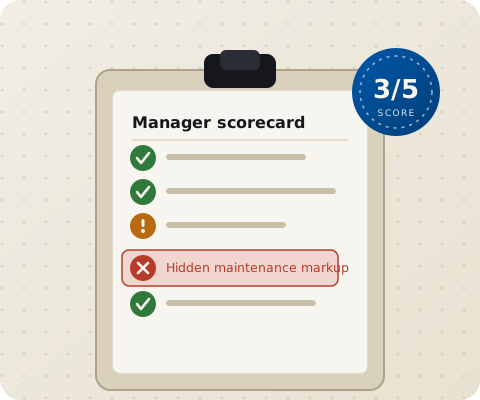
The three-vendor audit produces a real number in 30 minutes
Stop guessing whether your firm marks up vendor invoices. Run the audit. Here's how:
- Pull three vendor invoices from your last 12 months of owner statements. Pick different vendor types ideally — a plumber, an electrician, an HVAC or handyman. Different trades catch different markup patterns; some firms mark up some categories more than others.
- Call each vendor directly. Tell them you're the property owner and you're reconciling your books. Ask what they actually charged for that specific job on that specific date for that specific address. Most vendors will tell you immediately or pull the invoice within a minute.
- Compare each vendor's number to your statement line item. If the numbers match within a few dollars (sales tax rounding accounts for small variance), no markup is being applied. If there's a meaningful gap — 10%, 15%, 20% — that's your markup rate.
- Multiply the markup rate by annual maintenance volume. Pull the year's total vendor spend off the December owner statement. Multiply by the markup rate. That's the annual dollar cost of the markup on your unit.
The audit takes about 30 minutes and produces a real dollar number rather than a hunch.
What if the firm uses a flat coordination fee instead?
Some California firms structure the maintenance surcharge as a flat dollar amount per work order rather than a percentage of the invoice — typically $25 to $75 per dispatch. The audit method is the same: compare your statement to the vendor's invoice. If your statement shows the vendor invoice plus a separate line item labeled "coordination" or "work order fee" or similar, that's a disclosed flat fee.
Flat coordination fees aren't inherently bad. A clearly-disclosed $40 per work order is more transparent than an undisclosed 15% markup. The risk with flat fees is dispatch frequency — a firm that routinely sends a vendor for items that could be handled by phone is multiplying flat fees you didn't need to incur.
Typical markup ranges in California PMAs
| Structure | Common range | Disclosure typically |
|---|---|---|
| Percentage markup on vendor invoice | 10% to 20% | Disclosed in PMA, sometimes vaguely |
| Flat per-work-order fee | $25 to $75 | Usually disclosed as line item |
| Captive in-house vendor pricing | Varies; often 20-40% above market | Not usually disclosed as markup |
| Pass-through at vendor cost | 0% (no markup) | Sometimes a selling point |
The captive in-house vendor structure is the least transparent. A firm with an owned or affiliated maintenance company can charge "market rate" to the owner while paying the affiliated company much less, capturing the spread internally. The audit catches this because you're comparing your statement line to what the actual on-site vendor was paid — the in-house labor cost typically diverges from the rate billed to the owner.
Whether undisclosed markups are recoverable
California real estate brokers acting as property managers owe fiduciary duties to their owner-clients. The duties include loyalty (acting in the owner's interest, not the firm's), full disclosure of all material facts including compensation arrangements, and care in handling owner property and funds. These are statutory and case-law obligations, separate from the PMA itself.
A markup that was clearly disclosed in writing at PMA signing — with specific percentage or dollar amount — is enforceable by contract. The owner consented.
A markup that was not disclosed, or that was disclosed in vague language ("a reasonable administrative fee"), or that was disclosed at a lower rate than what's actually being applied, raises a fiduciary-duty issue. Where the duty was breached, the markup may be recoverable as restitution. This is a fact-and-amount question. For modest overcharges, small claims court (under $12,500 for natural persons in California) is the typical venue and self-representation is practical. For larger amounts, an attorney specializing in California real estate broker liability is the right consultation.
DRE complaints are also an option for systemic markup non-disclosure. The DRE's enforcement focus on fiduciary-duty violations is real, and a documented pattern across multiple owners is the kind of complaint they investigate.
The demand-letter sequence
- Complete the audit with three vendor invoices and the math written down.
- Send a written demand to the firm by USPS certified mail. Include the audit findings (vendor X charged $A, statement showed $B, gap of $C, applied across $D total annual vendor spend = $E recoverable). Request either refund of the overcharges or a full accounting reconciling the variance. Set a five-business-day response deadline.
- Evaluate the response. A clean firm produces a reconciliation showing line-by-line how the statement matches vendor invoices (possibly with disclosed markup explicitly noted). A non-clean firm offers vague explanation, refuses to reconcile, or doesn't respond.
- Decide the path. Settlement and continue (rare), terminate and recover separately (most common), or escalate to DRE and attorney consultation (when amounts are large or there's evidence of systemic pattern).
- If terminating, use the for-cause termination framework. Documented fiduciary-duty violation supports termination without paying any early-termination fee. See the complete playbook.
What to demand in a future PMA to avoid this
Whether you stay with your current firm or switch, the PMA terms that prevent this problem:
- Explicit markup language — either "zero markup; vendor invoices passed through at cost" or a specific disclosed percentage with cap.
- Owner right to audit — explicit contractual right to request vendor invoices and compare to statement entries, with a defined response time.
- Vendor list disclosure — the firm discloses any ownership or affiliation interest in maintenance vendors used on your property.
- Spending threshold — any single work order above a defined amount (commonly $300-$500) requires owner pre-approval.
- Three-bid requirement on work orders above a defined amount.
NGC's standard PMA includes all five and is one page on the fee/maintenance section. The structure is: 5.9% on collected rent, vendor invoices passed through at cost, no markup, no coordination fee, owner audit rights explicit.
30-minute call. We run the audit with you live.
Send us three vendor invoices from your last year of owner statements. We sit with you on the phone, dial the vendors, and watch the math come out in real time. Whatever the markup spread is on your specific property, you have a real number by the end of the call.
Schedule the call → Or generate the termination letter