Hidden Fees on Your California Property Management Statement
The headline management percentage rarely tells the full story. A 6% PMA with three layered hidden fee categories can cost more annually than a 7% all-inclusive structure. A 7% with maintenance markup can effectively cost 10%. The audit takes 30 minutes and identifies whether your firm is operating cleanly or quietly extracting value through line items the headline rate doesn't capture. The seven categories below cover roughly 95% of the hidden-fee patterns owners encounter on California PMAs.
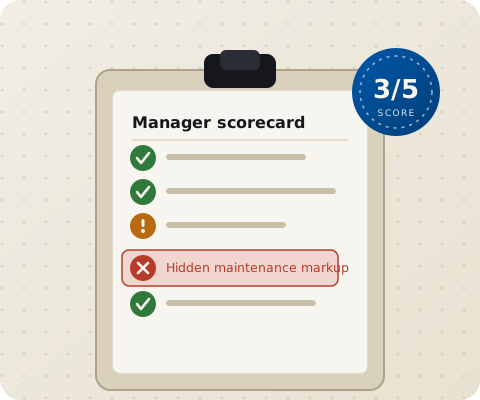
The seven common hidden-fee categories
1. Maintenance markup on vendor invoices
The biggest category, by dollar impact, on most California PMAs. The firm dispatches a vendor, the vendor performs the work, the vendor sends the firm an invoice, and the firm passes the charge through to your owner statement — sometimes at the actual vendor amount, sometimes with a 15–20% surcharge added on top. The surcharge is rarely labeled as a markup. It shows up as a vendor cost that's just higher than what the vendor actually billed.
On a unit with $5,000 of annual maintenance and a 20% markup, the hidden cost is $1,000/year. On a 4-unit small multifamily with $15,000 of annual maintenance and a 20% markup, the spread clears $3,000/year. The audit is three vendor phone calls. See the three-vendor audit method.
2. Lease renewal fees on existing tenants
Some PMAs charge a separate fee — sometimes a full month's rent — when an existing tenant signs a renewal lease. The economic logic is hard to justify: renewing an existing tenant is the cheapest event in the management cycle (no marketing, no showings, no application processing, no move-in coordination). A renewal fee on top of the monthly management percentage is structural overcharging.
Some firms include the renewal fee in the standard PMA fee schedule (technically disclosed but worth pushing back on at signing). Others impose it without explicit disclosure, which is contractually weaker.
3. Platform or technology fees
A monthly per-unit charge for the firm's owner portal. Typical range is $10–$50/month per unit when charged. Some firms apply it across all units; some apply it only to units that use specific features.
Owner portals are standard infrastructure in 2026, not optional value-added services. A separate platform fee on top of the management percentage is a structural overcharge that didn't exist in California PMAs five years ago. Some firms have started embedding the platform cost into their headline rate (better); others charge separately (worse).
4. Inspection fees
Per-visit or annual charges for property inspections, $75–$250 per inspection. Some firms charge for routine annual inspections that should be included in standard property management at the headline rate. Others charge for owner-requested ad hoc inspections beyond the standard cadence (more defensible).
The distinction matters: routine annual inspections fall within standard PM duties. Charging separately for them is structural overcharging. Owner-requested off-cadence inspections fall outside standard duties and can reasonably carry a separate fee.
5. Records-turnover fees on termination
Some firms charge $200–$500 to "transfer records" when an owner terminates. The legal position is that records belong to the owner under California real estate licensing rules; the firm has no contractual right to charge for handing them over. Despite this, firms charge the fee anyway and many owners pay it to avoid friction at exit.
Refuse the charge. If the firm withholds records over the fee, that's a DRE matter under record-keeping regulations and can support a DRE complaint. See record-keeping requirements.
6. Administrative or processing fees
Generic line items labeled "administrative fee," "processing fee," "service charge," or similar, without a specific service explanation, appearing on owner statements. These charges are diagnostic because they often don't tie to a specific PMA clause or specific work performed.
The contractual test: identify the specific PMA clause that authorizes the charge category, and the specific service or work that the charge represents. A firm with legitimate basis can produce both. A firm without legitimate basis either deflects or provides vague generic explanations.
7. Listing-protection or post-termination commission claims
Some PMAs include a clause that claims a commission on lease renewals signed within a defined window (often 90–365 days) after termination. The rationale is that the firm "earned" the future commission by placing the tenant. The clause's enforceability turns on Civil Code §1671(b)'s reasonableness test — punitive clauses that capture revenue the firm wouldn't have earned otherwise often fail when challenged. See listing-protection guide.
Are undisclosed fees legal in California?
Two analytical layers determine whether a hidden fee is enforceable:
Layer 1: Contract law
If the fee is explicitly disclosed in writing in the PMA, it's enforceable by contract regardless of whether owners like it. The PMA is the controlling document. A fee that's in the fee schedule, in plain language, with a specific dollar amount or percentage, is contractually binding.
If the fee isn't disclosed in writing, it's contractually unsupported. The firm can't add a new fee category mid-PMA without owner consent. A charge that shows up on owner statements without corresponding language in the original PMA fee schedule is grounds to dispute on contract grounds alone.
Layer 2: Fiduciary duty
California real estate brokers acting as property managers owe their owner clients fiduciary duties — loyalty, full disclosure of compensation, accounting, care, and obedience. The fiduciary disclosure obligation requires brokers to tell owners about all compensation they receive in connection with the relationship. See fiduciary duty explained.
A fee that wasn't disclosed at signing — even if technically buried in a generic catch-all clause — may breach the fiduciary disclosure duty. Damages can include disgorgement of the undisclosed compensation. The analysis is fact-specific and the dollar amount usually determines whether attorney involvement makes sense.
The strongest cases involve clearly-undisclosed maintenance markup or vendor kickback arrangements where the firm received compensation the owner had no way to know about. The weakest cases involve fees disclosed in fine print that the owner could have read at signing.
How to identify hidden fees on your statements: the 30-minute audit
- Pull your last 12 months of owner statements. The longer the time window, the clearer the pattern.
- Pull your original PMA including all amendments. Find the fee schedule.
- Match every line item on the statements to a specific PMA clause. Each charge category should map to a specific disclosed fee. Categories that don't map are contractually unsupported.
- Run the three-vendor markup audit. Pick three vendor charges, call each vendor, ask what they billed. Identify any markup spread.
- Compute the all-in annual cost. Add management fee + lease-up (amortized) + any other layered charges + maintenance markup spread. Compare against your unit's annual rent to get the true effective rate.
The audit produces three categories of finding: charges that map cleanly (legitimate), charges where the PMA is ambiguous (renegotiation candidates), and charges that don't map at all (challenge candidates).
The written-demand sequence
For charges that don't map cleanly to PMA language, the response is a written request for the contractual basis. The three-question template:
- "What specific work or service produced this charge on [statement date], unit [X], amount $[Y]?"
- "Which specific clause of the Property Management Agreement authorizes this charge category?"
- "Where is the supporting documentation filed, and can you send me a copy?"
Send by email so you have a written record. Keep the response (or non-response) on file. A firm with legitimate basis answers all three questions specifically and produces documentation within a few days. A firm without legitimate basis either deflects, references a generic "operational costs" rationale, or doesn't respond.
The non-response is itself the answer. Document it.
What to do when challenges fail
If the firm refuses to remove or justify undisclosed fees after written demand, escalation runs in escalating order:
- Renegotiate the PMA in writing. Propose either elimination of the contested fee category, or conversion to an explicit disclosed structure. The firm either accepts (the issue resolves) or refuses (clean grounds to escalate).
- Document the pattern across multiple months. Pattern documentation matters if you later need to support a termination for cause or a DRE complaint. Save the firm's responses (or non-responses) to your written challenges.
- File a DRE complaint citing fiduciary-duty breach if the pattern involves undisclosed compensation (kickbacks, maintenance markup not disclosed at signing). See DRE complaint guide. The DRE addresses regulatory and license-discipline outcomes, not direct money recovery.
- Small claims court for paid charges. For unauthorized charges already paid, under the California small-claims jurisdictional limit (verify current limit at selfhelp.courts.ca.gov), small claims can recover with a judgment.
- Switch managers. If the audit reveals enough hidden fees to materially change the all-in cost, the math usually says switch to a firm with a transparent fee structure. See how to fire your property manager.
Preventing hidden-fee exposure when signing a new PMA
The best protection is at signing, before any fee is collected. Three steps before signing any California PMA:
- Demand a complete written fee schedule. Every fee category, every dollar amount, every percentage. If the firm is reluctant or refuses to put it all in writing, that's the answer about whether to sign.
- Ask explicitly about maintenance markup. "Do you apply a markup to vendor invoices? At what percentage?" The answer goes in writing as part of the PMA, or attached as an addendum. A clean firm answers with a specific number or "zero."
- Negotiate out catch-all language. Clauses like "and such other reasonable fees as the manager may impose from time to time" allow the firm to add fees later. Strike or narrow these. Real fees should be specifically enumerated.
30-minute call. We map every line on your statement.
Send us your last three monthly owner statements plus your PMA. We identify every charge that doesn't map to a specific PMA clause, run the three-vendor markup audit live on the call, and tell you the true all-in annual cost on your unit. If everything reconciles cleanly, we say so — sometimes the audit comes up clean and the question is just whether the fee structure is competitive.
Schedule the call →