Hire a Property Manager or Self-Manage? The Honest Comparison
Self-managing a California rental looks free on the surface — no management fee, no leasing fee. The actual cost lives in three places the management fee doesn't appear: the time you spend operating the unit, the statutory-compliance exposure you carry alone, and the tenant-screening and vendor-network risk you absorb personally. The right decision depends on which of those costs you can reasonably bear. The comparison below is built to clarify which path actually fits your situation.
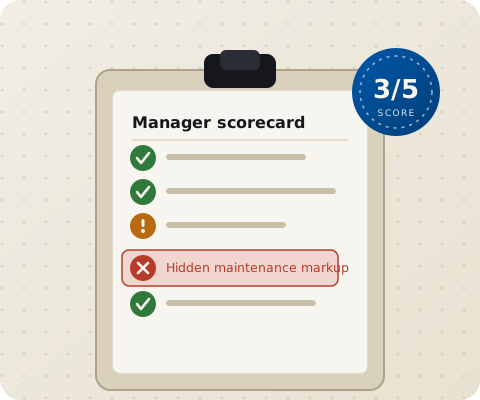
The visible math: what each option costs in headline dollars
On a typical $4,000/month Orange County rental, the headline dollar comparison runs roughly:
| Cost category | Self-management | Full-service PM (5.9%) | Full-service PM (8%) |
|---|---|---|---|
| Annual management fee | $0 | $2,832 | $3,840 |
| Lease-up fee at turn (amortized over 2-yr avg tenancy) | $0 | $2,000 | $2,000 |
| Software / tools (Cozy, Avail, RentRedi, etc.) | $200–$500 | Included | Included |
| Maintenance markup (if any) | $0 | $0 | $500–$1,500 |
| Headline annual cost | $200–$500 | ~$4,832 | ~$6,340–$7,340 |
On headline dollars alone, self-management saves $4,000–$7,000 per year per unit. That's a real number. But it's only part of the story.
The time math: what self-managing actually consumes
Self-managing a California residential rental is not zero-effort. The realistic time investment in steady-state operations runs:
- Rent processing: 1–2 hours/year per unit (collecting payment, posting to ledger, depositing if not ACH)
- Tenant communication: 2–5 hours/year (routine questions, lease items, neighbor-relations issues, scheduling)
- Maintenance dispatch and vendor management: 2–5 hours/year (vendor selection, scheduling, invoice review, payment)
- Owner-side bookkeeping: 1–2 hours/year (tracking income and expenses for tax, building the 1099 packet for vendors)
- Compliance reading: 1–2 hours/year (staying current on AB 1482 cap recalculations, AB 12 amendments, SB 567 updates, local ordinances)
Steady-state total: roughly 7–16 hours per unit per year, allocated unpredictably across the calendar. Plus turn cycles:
- Marketing the vacant unit: 3–8 hours (photos, listings on multiple platforms, copywriting)
- Showings: 5–15 hours over a 2–4 week marketing window
- Application review and tenant screening: 3–6 hours (credit checks, reference calls, employment verification, fair-housing-compliant decision-making)
- Lease signing and move-in inspection: 2–4 hours
- Move-out inspection, deposit accounting, and 21-day return: 3–6 hours
Per-turn total: 16–39 hours. On a long-term tenancy that averages 2 years, that allocates as 8–20 hours/year for the turn-cycle work.
Annualized total time investment: roughly 15–36 hours per unit per year for stable operations. Difficult tenant situations (late rent, habitability complaints, eviction proceedings) add substantially more time concentrated in compressed windows.
At a personal hourly value of $50/hour, that's $750–$1,800/year of your time per unit. At $100/hour, it's $1,500–$3,600. The implicit time cost approaches or exceeds the headline management fee for many California owners.
The statutory-compliance exposure
California rental law gets denser every legislative session. The compliance burden is the part of self-management that's most undervalued by owners until something goes wrong. The applicable framework on a typical California residential rental:
- AB 1482 rent cap (5% + regional CPI, capped at 10%) and just-cause eviction framework. See AB 1482 guide.
- AB 12 one-month security deposit cap effective July 1, 2024. See AB 12 guide.
- SB 567 tightened just-cause provisions effective April 1, 2024. See SB 567 guide.
- Civil Code §1950.5 security deposit handling, 21-day move-out accounting. See §1950.5 guide.
- Civil Code §1962 owner/manager identification disclosures to tenants. See §1962 guide.
- Civil Code §1941 implied warranty of habitability. See habitability guide.
- Fair housing under federal FHA + California FEHA, including source-of-income protection. See fair housing guide.
- Local rent ordinances in Santa Ana, Long Beach, LA, San Francisco, Oakland, Berkeley, Santa Monica, West Hollywood, San Jose, and a growing list. See CA rent control cities.
The cost of getting any one of these wrong typically exceeds the annual management fee saved by self-managing. A single miscalculated rent increase under AB 1482 can roll back to the pre-overage figure and create multi-year exposure. A late or non-compliant deposit return under §1950.5 can trigger statutory damages of up to twice the deposit. A fair-housing screening violation can produce six-figure settlement exposure.
If you read landlord-tenant law for fun or have a paralegal-level interest in compliance, self-management on the legal front is manageable. If you don't, the failure mode is expensive in ways that don't show up until they show up.
The tenant-screening question
Tenant screening on a California rental is fair-housing-regulated work. The criteria you use, the documentation you collect, and the way you communicate denials all carry legal weight. Self-management means developing this competence yourself or accepting elevated risk.
What proper California screening looks like:
- Written screening criteria document applied uniformly to all applicants
- Income verification at consistent multiples (typically 2.5–3x rent), with documented exceptions for housing vouchers under California's source-of-income protection
- Credit and background checks through compliant providers
- Prior landlord references verified by phone, with documented questions
- Employment verification through HR or payroll, not just paystubs
- Adverse action notices when denying based on credit or background
- Reasonable accommodation handling for disability-related requests
The screening risk on a single bad tenant placement — eviction costs, lost rent, damage, legal time — routinely exceeds $5,000–$15,000 in California. Strong screening reduces the probability of placing a problem tenant from roughly 1-in-10 to roughly 1-in-30. A property manager who places hundreds of tenants per year has substantially better screening discipline than a part-time self-manager can build.
The vendor network question
Maintenance happens regardless of who manages the unit. The question is who's on call when the water heater fails at 9pm on a Saturday.
A self-managed unit requires you to build and maintain a vendor list for every category you might need: plumber, electrician, HVAC tech, handyman, painter, landscape, roofer, pest control, gas-line specialist. Each vendor needs to be vetted, priced, available, insured, and ideally reachable on short notice. Building the list from scratch takes 6–18 months of trial-and-error. Maintaining it requires ongoing relationship work.
A full-service property manager arrives with the vendor list. The list is vetted, priced through repeat-business relationships, and dispatched on standard SLAs. For owners who don't already have a vendor network on the unit, this is a real value transfer.
When self-management actually pencils
Five conditions where self-management is the right call:
- You live within an hour of the unit. Physical proximity reduces the marginal cost of every operational task.
- You hold one or two units. Scale economies for property managers kick in around three units; below that, the fee is high relative to the value.
- You're actively current on California rental law. You read updates each legislative session, you have working knowledge of AB 1482, AB 12, SB 567, §1950.5, fair housing.
- You enjoy or don't mind the operational work. Some owners find the work satisfying; for them, the time isn't "cost" in the same sense.
- Your hourly value at the margin is low. If your time isn't otherwise allocated to higher-value work, the time cost of self-management approaches zero.
When hiring a property manager is the right call
Five conditions where hiring is the right call:
- Your hourly time value is meaningful and your time is otherwise allocated to higher-value work.
- You live more than an hour from the unit. The marginal cost of every operational task increases dramatically with distance.
- You hold three or more units. Scale economies make the per-unit management fee reasonable while consolidating operations under a single vendor network and compliance program.
- You're not actively current on California rental law. The compliance burden is real and the failure modes are expensive.
- You've experienced a difficult tenant situation that consumed weeks of your attention. The asymmetry of difficult situations — rare but extremely costly when they happen — favors paying for professional management as insurance against the bad-case scenarios.
The hybrid: leasing-only vs full-service vs DIY
For owners who want to self-manage day-to-day but get professional help on the high-skill events, the "leasing-only" model is a middle path. A leasing agent or placement service finds you a tenant for a one-time fee (typically one month rent) and steps away. You handle ongoing operations.
This works when the operational steady-state is genuinely cheap for you to absorb but tenant screening and lease signing are the parts you don't want to handle yourself. See property manager vs leasing agent for the full comparison.
How to decide for your specific situation
Three calculations decide the question:
- Estimate your annualized time cost. Realistic hours per unit per year, multiplied by your honest hourly value at the margin. For most California owners with full-time work and other priorities, this lands $1,500–$4,000/year per unit.
- Add a risk premium for compliance and tenant-screening exposure. If you're not actively current on California law and don't have a strong screening process, the expected-value cost of self-management is higher than the headline time cost suggests. A 10–20% premium on the time-cost estimate is reasonable.
- Compare to total annual cost of a full-service property manager. Add management fee + amortized lease-up + any hidden fee categories. Compare on your specific unit at your specific rent.
If the math is close, lean toward self-management. If the management fee comes in materially below your annualized time-and-risk cost, hire.
30-minute call. We tell you honestly which path fits your unit.
Send us your unit details, your current operational rhythm, and an honest estimate of your hourly time value. We run the comparison and tell you whether full-service makes sense for your situation. If self-management is the right call for you, we say so — some owners legitimately don't need us.
Schedule the call → Read the full comparison