Is a 10% Property Management Fee Justified in California?
10% sits at the top of the typical California property management market range. The question for an owner currently paying 10% isn't really "is this reasonable for full-service?" — the market answer is mostly no, since flat-fee operators at 5.9% are now widely available across Orange County and the rest of the state. The question is "is there a specific reason — service quality, property complexity, or value-add features — that justifies keeping this rate?" The audit usually decides quickly.
Where 10% sits in the California market
California residential property management fees on long-term rentals cluster in three tiers:
- Discount tier (5–6%): Flat-fee operators and lean independent brokerages. Typically all-in with no maintenance markup. NGC's flat 5.9% sits here.
- Mid-market tier (7–9%): The dominant range. Most established Orange County firms price here. 7–9% can be all-in or come with add-on fees depending on the firm.
- Premium tier (10%+): Top of the market. Sometimes justified by genuine specialty service, often legacy pricing that hasn't compressed with the broader market.
10% in 2026 isn't where the California market is. Flat-fee operators have meaningfully expanded since 2020, and most owners now have credible alternatives at significantly lower headline rates. A firm that hasn't adjusted its 10% pricing structure is either (a) confident the service quality justifies the premium, or (b) hoping clients don't run the comparison. The audit identifies which.
The annual math, plain
The 10% rate compounds quickly across rent levels and portfolio size. Here's what it costs annually, and the gap against a 5.9% flat-fee structure:
| Monthly rent | 10% monthly fee | 10% annual | 5.9% annual | Annual spread |
|---|---|---|---|---|
| $2,500 | $250 | $3,000 | $1,770 | $1,230 |
| $3,000 | $300 | $3,600 | $2,124 | $1,476 |
| $3,500 | $350 | $4,200 | $2,478 | $1,722 |
| $4,000 | $400 | $4,800 | $2,832 | $1,968 |
| $5,000 | $500 | $6,000 | $3,540 | $2,460 |
| $6,000 | $600 | $7,200 | $4,248 | $2,952 |
| $7,500 | $750 | $9,000 | $5,310 | $3,690 |
| $10,000 | $1,000 | $12,000 | $7,080 | $4,920 |
The spreads at 10% are substantial. On a single $4,000/month unit, the annual gap to a 5.9% flat-fee operator is roughly $2,000 per year. On a small portfolio of three units, that's $5,904/year. On 10 units at $4,500 average rent, the spread approaches $19,000 per year. Add a typical 15–20% maintenance markup and the all-in spread can clear $25,000/year on a small multi-unit portfolio.
At these numbers, the question isn't whether the switch math pencils — the question is whether anything the 10% firm delivers is worth the spread. The answer needs to be specific and defensible.
When 10% can actually be justified
There are specific situations where 10% genuinely earns its rate. If your situation fits one of these, stay with the firm. If it doesn't, the math says switch.
Luxury rentals with concierge-grade service expectations
Properties at the top of the rent stack — coastal Newport Beach, Laguna Beach luxury, ultra-prime Hollywood Hills, exclusive condo towers — sometimes warrant higher management fees because the tenant base demands hospitality-grade response. Tenants at $15,000+/month rent expect property issues handled within hours, vendor work performed by specialists who match the property's finish level, and discretion in communication. A 5.9% flat-fee operator running on a standardized vendor network can underdeliver in this space. A specialty firm operating at 10% with the right concierge infrastructure can earn it.
The screen: is your unit at the rent level where concierge service is actually expected by tenants? If yes, 10% with explicit concierge value-add is reasonable. If you're at $4,000/month, you're not in this category.
Unusual property complexity
Some California properties operate under enough overlapping rules that they require specialty handling beyond what a standard PM playbook covers:
- Historic-district units routing every exterior change through municipal preservation review
- Equestrian-zoned properties with on-site horse-keeping and the maintenance scope that creates
- Multi-unit buildings with on-site ADUs operating under different occupancy rules
- Mixed-use properties combining commercial and residential
- Properties under multiple HOA layers with active architectural enforcement
- Beach-zone properties under Coastal Commission jurisdiction for any structural work
If your property fits one of these and the 10% firm has demonstrated genuine specialty expertise, the premium can be defensible. The audit: ask the firm in writing for examples of how they've handled the specific complexity on similar properties. Concrete examples are a real answer.
Genuine value-add services beyond standard PM
Some firms layer in services that aren't standard property management:
- Full tax accounting and preparation, not just 1099 reporting
- Asset-management work beyond unit operations — capital improvement planning, refinance support, exit-strategy analysis
- Concierge tenant services beyond what the lease requires
- Specialized compliance work (Section 8, affordable housing, military housing)
If you're paying for and using these services, 10% may pencil. If you're paying for them but not using them, you're overpaying.
Long-term-stability portfolios where switching cost is meaningful
For owners with 10+ years of relationship with a firm, where the firm holds deep institutional knowledge of the portfolio, where switching would require significant onboarding effort, and where the firm has performed cleanly throughout, 10% may be sticky pricing that's still rational. The math: estimate the one-time cost of switching (records audit, tenant disruption risk, learning curve) against the annual fee spread. If switching cost exceeds 12–18 months of fee differential, staying can pencil.
When 10% is structural and not justified
Most 10% PMAs in the California market today don't fit the justified categories. The unjustified 10% typically shows one or more of these markers:
- Same playbook as the firm's 7% clients. Owner gets standard rent collection, standard maintenance dispatch, standard owner statements. The 10% rate is structural pricing the firm set years ago and never updated.
- No specialty differentiator. The firm has no specific competency in luxury, historic-district, equestrian, mixed-use, or other complexity. They handle your property identically to any other unit on their roster.
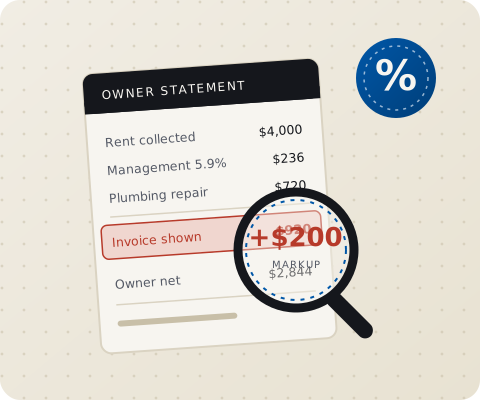
- Maintenance markup on top. 10% headline plus 15–20% vendor markup is an effective 12–14% rate on units with meaningful annual maintenance. At this combined level, the switch math is rarely close.
- Lease renewal fees on existing tenants. Charging a separate fee at renewal on top of 10% management is structural overcharging.
- Resistance to renegotiation. A firm confident in its 10% value should be willing to articulate it in writing. Refusal to engage with the renegotiation question is itself the answer.
The renegotiation conversation
Before switching, give the firm one written shot at renegotiation. Some firms will negotiate meaningfully when faced with a clear exit threat. The conversation goes in writing, not by phone:
Send an email referencing your specific units, your time with the firm, and the current California market context. Ask three things explicitly:
- "What service does this firm deliver at 10% that a flat-fee operator at 5.9% doesn't?" Genuine concierge services or specialty expertise should be articulable in concrete terms.
- "Would you reduce my rate to 7% all-inclusive, in writing as a contract amendment, with no maintenance markup and no separate renewal fees?" A reasonable counter-offer that the firm can accept, modify, or refuse.
- "If we can't reach agreement, what's the cleanest termination process given my current PMA's terms?" Sets up the exit cleanly if the negotiation doesn't work.
The response tells you whether the firm is worth keeping. A specific value-articulation plus a reasonable counter-offer is a firm that's earning its rate. A refusal to engage, a generic "we don't negotiate," or vague references to "the value we provide" without specifics is the firm telling you the 10% rate isn't structurally defended.
The audit before you switch
Even when the 10% rate isn't defensible, switching should follow a clean audit so you're not trading one problem for another. Five things to confirm before signing with a new firm:
- The three-vendor markup audit on your current statements. Pull three vendor invoices from the last year, call each vendor, ask what they charged. Calculate the current firm's effective rate including any markup. Full audit method here.
- The new firm's all-in fee schedule. Get every charge category in writing — management fee, lease-up, renewals, inspections, platform fees, ETF on the new PMA. Calculate the all-in annual cost on your specific unit before signing.
- DRE license verification. Confirm the new firm's responsible broker is active and clean at dre.ca.gov. License verification guide.
- Switching mechanics review. Confirm the new firm handles the 30-day clock, records audit, deposit transfer under §1950.5, and tenant notification under §1962 as part of the standard onboarding. Full switching playbook.
- ETF analysis on your current PMA. If the current 10% PMA carries an early-termination fee, evaluate whether it survives Civil Code §1671(b)'s reasonableness test. §1671(b) explainer.
30-minute call. Send us your 10% PMA before the call.
We read your current management agreement, run the three-vendor audit on a year of your statements, calculate the all-in annual spread against NGC's flat 5.9% structure, and tell you honestly whether the switch math justifies the move on your specific portfolio. If the analysis says stay where you are, we say so.
Schedule the call → Or generate the termination letter