Is an 8% Property Management Fee Reasonable in California?
8% sits squarely at the mid-market median for Orange County and most California submarkets. Whether it's reasonable on your specific unit isn't really a question about the percentage — it's a question about what the firm actually delivers at that rate, what's layered on top, and whether the math beats what a flat-fee operator at 5.9% offers on the same unit. The answer is usually yes for some firms and no for others, and the audit takes about 20 minutes.
Where 8% sits in the California market
California property management fees on residential rentals typically cluster in three tiers. Knowing which tier you're paying lets you compare apples to apples.
- Discount tier: 5–6%. Flat-fee operators and lean independent brokerages. Usually all-in with no maintenance markup. NGC's flat 5.9% sits here.
- Mid-market tier: 7–9%. The dominant range in Orange County. Most established firms price here. Whether the fee is all-in or comes with add-ons depends on the firm.
- Premium tier: 10%+. Often legacy pricing that hasn't compressed with the market. Sometimes justified by genuine concierge service on luxury rentals; more often structural.
8% is the mid-tier median. It's not high or low in isolation. What makes it reasonable or unreasonable is what's bundled with it and what's billed separately.
The annual math, plain
Here's what 8% actually costs on common Orange County rent levels, and the spread against a 5.9% flat-fee structure on the same unit:
| Monthly rent | 8% monthly fee | 8% annual | 5.9% annual | Annual spread |
|---|---|---|---|---|
| $2,500 | $200 | $2,400 | $1,770 | $630 |
| $3,000 | $240 | $2,880 | $2,124 | $756 |
| $3,500 | $280 | $3,360 | $2,478 | $882 |
| $4,000 | $320 | $3,840 | $2,832 | $1,008 |
| $4,500 | $360 | $4,320 | $3,186 | $1,134 |
| $5,000 | $400 | $4,800 | $3,540 | $1,260 |
| $6,000 | $480 | $5,760 | $4,248 | $1,512 |
| $7,500 | $600 | $7,200 | $5,310 | $1,890 |
On a typical Orange County rental, the management-fee gap alone between 8% and 5.9% clears four figures per year per unit. On a small portfolio of three units, the spread compounds linearly: $3,000+ per year on a $4,000-rent portfolio. On a five-unit portfolio at $4,500 average rent, the gap is $5,670 per year. Run your specific math with the cost-of-switching calculator.
What should be included in an 8% full-service rate
At an 8% all-inclusive rate, the firm should be performing roughly the following without separate per-service charges:
- Monthly rent collection and owner disbursement on a predictable schedule
- Owner statement each month with full transaction-level detail and copies of vendor invoices for any maintenance charges
- Trust-account handling per B&P §10145 with monthly reconciliation
- Maintenance dispatch and oversight on tenant requests, with vendor invoices at cost (no markup)
- Vendor sourcing and management — the firm maintains a vetted vendor list for the unit's region
- Tenant communication — maintenance requests, payment reminders, lease-related questions, in the appropriate language for bilingual markets
- Lease renewal coordination when existing tenants extend — not a separate fee on top
- Annual tax 1099 reporting to the IRS
- HOA coordination for condo and master-planned units — architectural review, master-association notification, dues reconciliation
- Compliance with current California law — AB 1482 rent cap, AB 12 deposit cap, SB 567 just-cause, Civil Code §1950.5 deposits, §1962 tenant notice, fair housing under FHA/FEHA, local rent ordinances where applicable
- Property inspection at least annually with written condition report
What's typically not included even at 8%: lease-up fee for placing a new tenant on a vacant unit (usually one month rent), substantial unit-turn or renovation coordination on owner-directed work, and eviction-related work if a UD is filed.
The hidden fees that compound on top of 8%
The headline percentage rarely tells the full annual story. Five categories of additional fees that frequently get layered on top of an 8% management rate:
1. Maintenance markup on vendor invoices
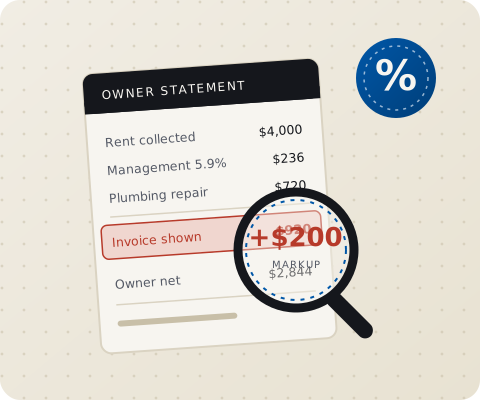
The biggest hidden cost. Some firms apply a 15–20% surcharge to every vendor invoice that flows through to the owner. The markup is rarely labeled as such on the owner statement — it shows up as a vendor cost that's just higher than what the vendor actually billed. On a unit with $5,000 of annual maintenance, a 20% markup costs you $1,000 extra per year — effectively converting an 8% headline rate into a 10.1% effective rate.
How to audit: pull three vendor invoices from the last 12 months of owner statements, call each vendor directly, ask what they charged. If the numbers match what your PMA company billed, no markup. If they don't, the gap is the markup. Full audit method here.
2. Lease renewal fee
Some firms charge a separate fee — sometimes a full month rent — when an existing tenant signs a renewal lease. Renewing an existing tenant should be the cheapest event in the management cycle (no marketing, no showings, no application processing). A separate renewal fee on top of the management percentage is a structural overcharge. Push back at signing or at renewal.
3. Platform or technology fees
A monthly per-unit charge ($10–$50/month is typical) for the firm's owner portal. Owner portals are standard infrastructure now, not an optional value-add. A separate platform fee on top of the management percentage is a structural overcharge that didn't exist in California PMAs five years ago.
4. Inspection fees
Annual or semi-annual property inspections charged separately at $75–$250 per visit. An annual inspection is part of normal property management at the 8% rate. Separate billing for it is a layered charge.
5. Records turnover or termination fees
Some firms charge $200–$500 to "transfer records" when an owner terminates. Records belong to the owner under California Department of Real Estate rules; the firm has no contractual right to charge for handing them over. Refuse the charge. If the firm withholds records over the fee, that's a DRE matter under record-keeping regulations.
When 8% is actually justified
There are situations where an 8% rate is reasonable and the firm earns it. Pay attention to these markers:
- Concierge service for luxury rentals. Properties at the top of the rent stack (above $8,000/month) sometimes warrant higher fees because the tenant base demands hospitality-grade response and the vendor network is specialized.
- Unusual property complexity. Historic-district units routing through preservation review, equestrian-zoned properties with horse-keeping operations, units with on-site ADUs or commercial components, properties under multiple HOA layers with active architectural enforcement.
- Genuinely included services that other firms charge separately. If the firm includes lease renewals, inspections, platform access, and HOA coordination without separate fees, an 8% all-in rate can be competitive on total annual cost against a 6% rate with three add-on fees.
- Specific value-add agreements. Some firms layer in full-service tax accounting, asset management above standard PM, or other genuine services. If you're paying for those and using them, 8% can be reasonable.
How to evaluate whether your 8% is worth it
The three-question test:
- What does this firm deliver at 8% that a 5.9% flat-fee operator doesn't? If the answer is a real concierge or specialty service line you actually use, the fee is justified. If the answer is "we've always charged 8%," it isn't.
- Is the firm applying a maintenance markup or layering add-on fees? Run the three-vendor audit. Pull a year of owner statements and identify every charge above the headline percentage. Calculate the true effective annual cost.
- What's the all-in cost comparison on your specific unit? Add 8% + maintenance markup + renewal fee + platform fee + inspection fee. Compare against a 5.9% flat-fee operator with no add-ons. The math usually decides.
If the audit shows you're paying 8% for service that genuinely warrants 8%, stay. If it shows you're paying 8% with layered fees that push effective annual cost above 10%, switch.
Negotiating an 8% rate down
If you've decided 8% is too high but you'd prefer to stay with your current firm, the path is a written renegotiation. The data points that strengthen your position:
- Time on platform — loyal multi-year clients have leverage
- Portfolio size — multi-unit owners can typically negotiate 50–100 basis points off the headline
- Market pressure — flat-fee operators expanding in your submarket give you a credible exit threat
- Compliance value-add — if the firm has been clean on AB 1482, §1950.5, and §1962 work, you can value that explicitly
A reasonable counter-offer to an 8% PMA: 7% with no maintenance markup and no platform fee, in writing as a contract amendment. The firm either accepts (meaning you got the spread back) or refuses (giving you cleaner grounds to switch). Either way, the renegotiation produces useful information.
30-minute call. We compare your 8% structure against NGC's flat 5.9%.
Send us your current PMA and your last three owner statements before the call. We map every fee in your contract, run the three-vendor markup audit, and show you the actual annual all-in cost. If the math doesn't favor switching, we say so.
Schedule the call → Or generate the termination letter