Flat-Fee vs Percentage Property Management — Which Costs Less?
California property management firms price two ways: a flat monthly dollar amount per unit, or a percentage of collected rent. Both structures have real strengths and real failure modes. The right structure for your unit depends on the rent level, the portfolio profile, and what hidden fees the firm layers on top. Headline rates rarely decide the question; annual all-in cost on your specific unit does.
How a flat-fee structure actually works
A flat-fee PMA charges a fixed dollar amount per unit per month, regardless of the rent collected. Typical California flat-fee structures run $150–$300/month per unit for full-service residential property management. The same dollar fee applies whether your unit rents at $1,800/month or $7,500/month.
This is structurally efficient on higher-rent units because the dollar fee doesn't scale up with rent. On a $7,500/month coastal Newport SFR, a $200/month flat fee is an effective 2.7% rate — far below the typical market percentage. On a $1,800/month inland unit, the same $200/month flat fee is 11.1% — well above market percentage rates.
The flat-fee model favors owners with concentrated higher-rent portfolios. It penalizes owners with lower-rent inventory.
How a percentage-fee structure actually works
A percentage-fee PMA charges a fixed percentage of collected rent each month. Typical California percentages run 5–10% of collected rent depending on the firm and the service tier. The fee scales proportionally with rent: higher rent means higher fee in absolute dollars, lower rent means lower fee.
On a $7,500/month rental at 8%, the monthly fee is $600. On a $1,800/month rental at the same 8%, the monthly fee is $144. The percentage stays the same; the dollars adjust with the rent.
This structure is more equitable for owners with mixed-rent portfolios — you pay proportional to what each unit produces. It's the dominant structure in California and the one most owners encounter by default.
The minimum-monthly floor: where percentage PMAs become flat fees
Many California percentage-fee PMAs include a minimum-monthly floor in the compensation clause. Read the language carefully because it changes the math significantly on lower-rent units.
Typical floor language: "Compensation equals 8% of collected rent, or $300 per month, whichever is greater."
What that means in practice: above $3,750/month rent ($300 ÷ 0.08), the percentage applies. Below $3,750/month, the floor kicks in. On a $2,000/month unit, the firm collects $300/month — effectively a 15% rate on that unit, even though the headline percentage is 8%. The floor exists to ensure the firm's per-unit revenue covers its operating cost on lower-rent inventory.
Floors are negotiable at signing and sometimes at renewal. They're rarely volunteered by firms operating below the floor — you have to read the clause and ask.
Side-by-side cost comparison on common California rent levels
Here's what each structure costs annually on typical Orange County rent levels, plus what NGC's flat 5.9% structure costs (a hybrid that uses percentage math but applies one of the lowest rates in the market):
| Monthly rent | Flat $200/mo annual | 8% percentage annual | NGC 5.9% annual | Best structure |
|---|---|---|---|---|
| $1,800 | $2,400 | $1,728 | $1,274 | NGC 5.9% |
| $2,500 | $2,400 | $2,400 | $1,770 | NGC 5.9% |
| $3,000 | $2,400 | $2,880 | $2,124 | NGC 5.9% |
| $3,500 | $2,400 | $3,360 | $2,478 | NGC 5.9% |
| $4,000 | $2,400 | $3,840 | $2,832 | Flat fee |
| $5,000 | $2,400 | $4,800 | $3,540 | Flat fee |
| $7,500 | $2,400 | $7,200 | $5,310 | Flat fee |
| $10,000 | $2,400 | $9,600 | $7,080 | Flat fee |
Pure flat-fee structures win at the top of the rent stack. Percentage structures with low rates (NGC's 5.9% or similar flat-percentage operators) win across most of the mid-market. Traditional 8–10% percentage structures lose to both alternatives in almost every scenario above $2,000/month.
How each structure handles vacancy
Vacancy is where flat-fee and percentage structures diverge sharply, and the divergence matters for owners with vacancy risk or unit-turn cycles.
- Pure percentage (no floor): No rent collected, no management fee. Zero economics during vacancy.
- Percentage with minimum floor: The floor applies during vacancy. If your PMA has a $300/month floor and your unit is vacant for 6 weeks, you owe roughly $400 in management fees that period even though no rent was collected.
- Pure flat fee: The flat fee applies in full during vacancy. A $200/month flat fee charges $200 in any month, vacant or occupied.
- Hybrid with vacancy clause: Some PMAs include explicit reduced-fee or suspended-fee language during defined vacancy periods. Check the clause.
For owners with stable long-term tenancies (multi-year leases, low turnover), vacancy clauses don't matter much. For owners with frequent turn cycles (higher-end coastal STRs, college-town rentals, military housing), vacancy economics can be a material part of the annual cost comparison.
Hidden fees that compound on top of either structure
The headline structure (flat or percentage) is only part of the math. Six categories of additional fees appear in PMAs of both types and need to be added to any honest cost comparison:
- Lease-up fee. Charged when the firm places a new tenant. Almost universally one month's rent in California, regardless of structure. Amortize over expected tenant duration to get the true annual impact.
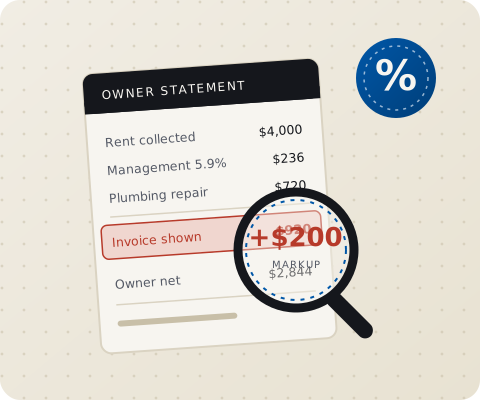
- Maintenance markup. Some firms add 15–20% to vendor invoices. Appears in both flat-fee and percentage PMAs. The three-vendor audit method identifies whether your firm applies one.
- Lease renewal fee. Some PMAs charge separately when an existing tenant renews. Sometimes a full month's rent. Structure-agnostic.
- Platform / technology fee. Monthly per-unit charge for the firm's owner portal. $10–$50/month per unit is typical when charged. Often appears in flat-fee structures as a structural add-on.
- Inspection fee. Per-visit or annual charges for property inspections, $75–$250 per inspection. Some firms include in base fee; others charge separately.
- Records-turnover fee on termination. Often $200–$500. Frequently unenforceable under California real estate licensing rules — records belong to the owner — but firms charge them anyway. See the post-termination charge guide.
The all-in annual cost on a specific unit can vary $1,000–$3,000 between two firms quoting the same headline rate, depending on which hidden fees apply. Compare quotes apples-to-apples by building the full annual total for each.
NGC's 5.9% flat-percentage structure: the hybrid approach
NGC's pricing is structurally a percentage fee (5.9% of collected rent) but at a rate substantially below the California market median. The structure combines the benefits of both pure flat fees and pure percentage fees:
- Scales with rent like a percentage, so lower-rent units don't pay a higher effective rate
- Sits at the low end of the market like a flat-fee operator, so higher-rent units don't pay a punitive percentage
- No minimum-monthly floor — vacant units owe zero management fee that month
- No maintenance markup on vendor invoices — vendor cost passes through at the actual vendor invoice amount
- No separate platform, inspection, or records-turnover fees
- No early-termination fee on the NGC PMA — 30-day notice ends the agreement cleanly
The math on a typical $4,000/month Orange County rental: 5.9% is $236/month or $2,832/year. Against a flat $200/month structure: NGC costs $432 more per year, but doesn't charge in vacancy and doesn't apply maintenance markup. On a unit with $3,000+ of annual maintenance and any vacancy risk, NGC's all-in cost beats the flat-fee alternative.
The decision framework, plain
Three questions decide which structure fits your unit:
- What's your unit's current rent? Above $5,000/month, pure flat-fee structures usually beat percentage structures — if the flat fee comes from a firm with no maintenance markup and reasonable add-on fees. Below $5,000/month, low-rate percentage structures (5.9% or below) usually beat flat fees because the percentage scales down with rent.
- What's the vacancy profile? Stable long-term tenancies favor pure percentage (no fee during vacancy). High-turnover or seasonal rentals favor flat-fee with explicit vacancy clauses or no-floor percentage structures.
- What's the maintenance volume? High annual maintenance volume favors firms with no maintenance markup — the markup spread can exceed the management-fee differential. Low maintenance volume reduces the markup question's weight.
The cleanest comparison method: get a written quote from each candidate firm, ask explicitly about every hidden-fee category, and calculate the full annual cost on your specific unit before signing. The headline rate is rarely the deciding factor.
30-minute call. Send us your unit details. We build the comparison.
We can compare NGC's 5.9% structure against any flat-fee or percentage-fee quote you've received, all-in across every fee category, on your specific unit. If a different structure beats us on the math, we say so on the call.
Schedule the call →